
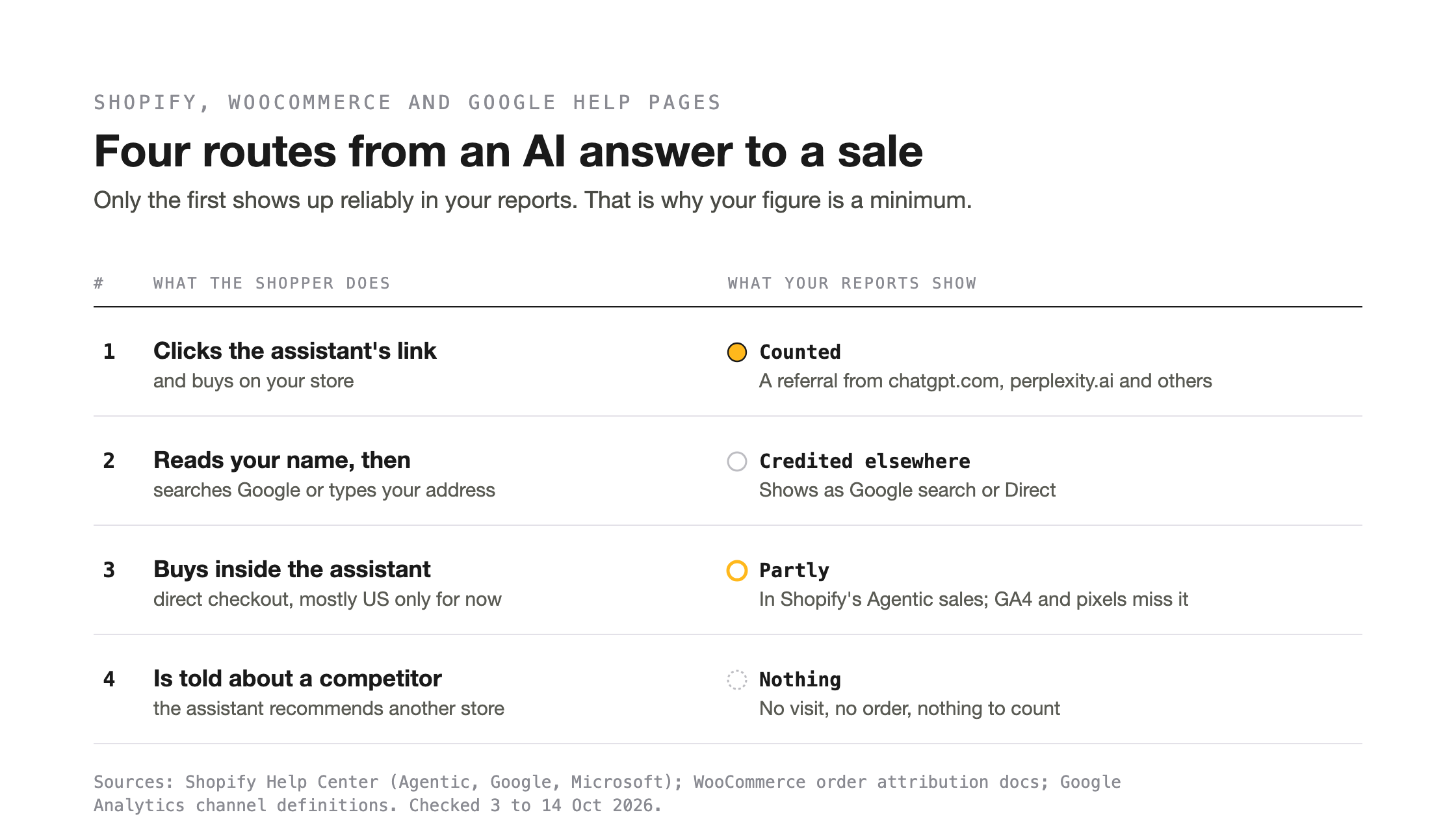
Your store’s reports count orders from shoppers who clicked a link in ChatGPT or another AI assistant. They miss shoppers who read about your store in an assistant, then came back through Google or by typing your web address. So the number you can pull today is a minimum. Your real sales from AI assistants are at least that, and probably more.
Shopify and WooCommerce both record where each order came from, and Shopify now has a part of its admin that reports AI channels by name. Google Analytics and the search tools from Google and Microsoft add more, and the industry figures in the headlines describe other people’s stores. Company pages are cited as they stood on 14 October 2026, except Shopify’s help pages and OpenAI’s pages, which are cited from Internet Archive copies dated 3 to 10 October 2026.
What Shopify and WooCommerce already count
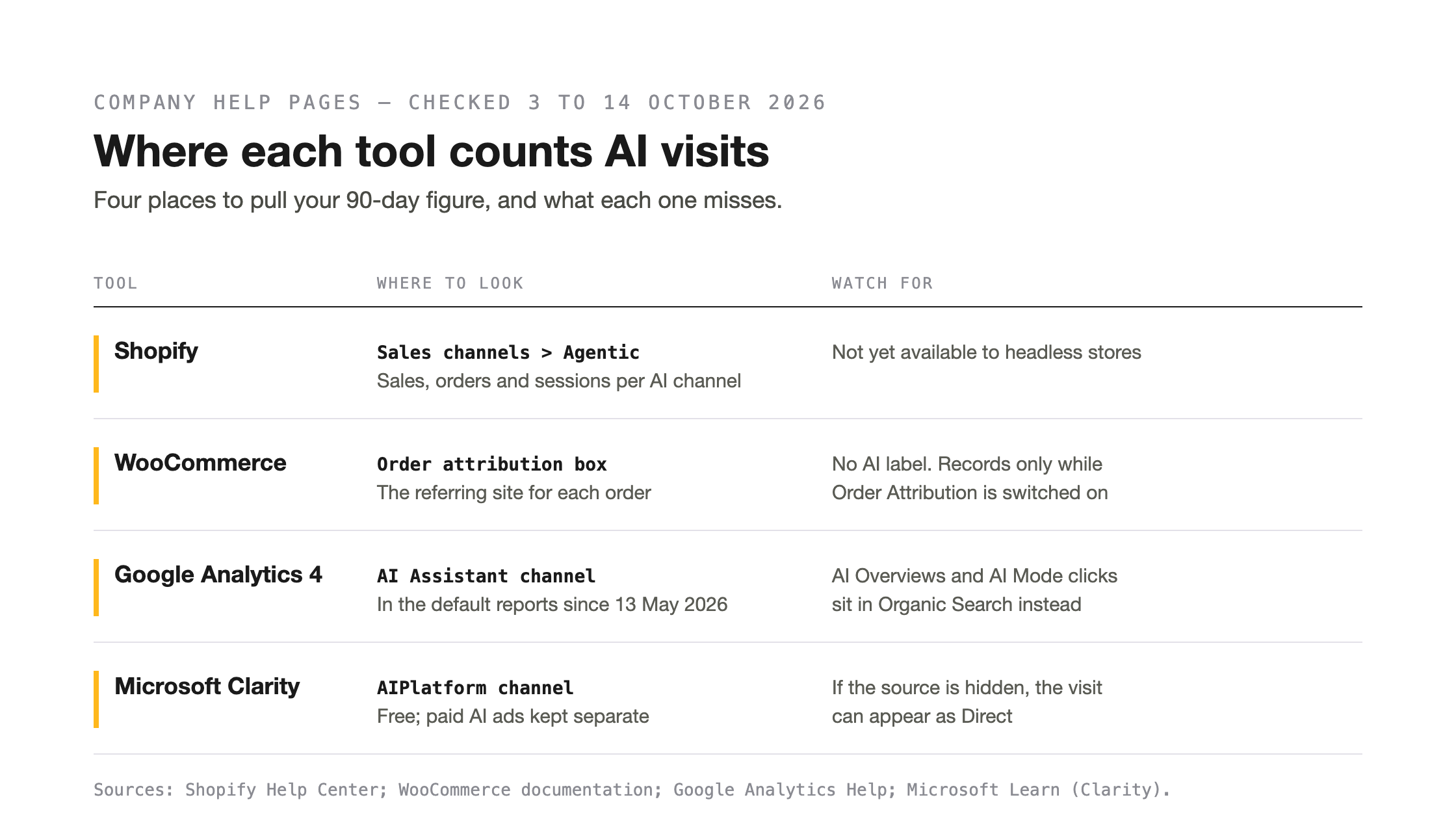
Shopify gives AI channels a report of their own. It sits in the admin at Sales channels > Agentic. Agentic here means AI that acts on the shopper’s behalf, the sense Google gives the word when it says its agentic checkout “buys things on the customer’s behalf”. Shopify’s help page says the section reports sales, orders, online store sessions and online store conversion for each AI channel, and it counts a session as a visit to your online store from an AI channel. Shopify’s sales figure in the Agentic section adds referral sales to sales made through direct checkout inside the assistant. A referral, in Google’s words, is a session that arrives “via non-ad links on other sites/apps”. The figure also includes the Shop app, Shopify’s own shopping app.
Shopify gave Agentic Storefronts its own page in the admin on 11 May 2026, its developer changelog says. Orders from AI channels show in your admin “with channel or referrer attribution”, according to Shopify’s agentic storefronts page. The referrer is the site the shopper came from, which WooCommerce’s documentation calls “the URL of the site that referred the visitor to your site”. Attribution is giving the credit for a sale to the click or source that led to it, as Google describes it. The feature is on by default for eligible stores. For ChatGPT, that means a store that sells to customers in the United States, Shopify’s ChatGPT page says, though the store can be based elsewhere. Headless stores, whose shopfront is built separately from Shopify’s own themes, do not get the reports yet. The section also has a search preview of how your products might rank in AI channels. Shopify says the preview can differ from what customers see in the assistant, and calls it “a directional signal, not an exact prediction”.
If the Agentic section is empty on your store, Shopify’s own blog gives a second route. Open any report in Shopify Analytics, choose Filters, select “Referrer name” or “Order referrer name” and enter “ChatGPT”.
WooCommerce takes more reading, because the order origins its documentation lists include no AI label. It records the source of each order with its Order Attribution feature. WooCommerce’s documentation says the feature stores the referring site and any UTM parameters for each order, and gives all the credit to the last interaction before the shopper landed on your site. UTM parameters are tags added to a link that tell your analytics where a click came from, according to Google. The feature only records orders placed while it is switched on, under WooCommerce > Settings > Advanced > Features.
You can read each order’s source in an Order attribution box on the order screen and in an origin column in the Orders table. WooCommerce’s origin values are Referral, Organic, UTM, Unknown and Type-in (Direct), for a shopper who typed your address. The referring site in those details is where to look for the assistant addresses listed at the end of this article. WooCommerce Analytics adds five Order Attribution reports, including Orders by Channel and Orders by Source, but the extension is in early access (beta) and built for single-currency stores. WooCommerce’s own post of 29 June 2026 says “there isn’t one perfect dashboard for tracking AI traffic” and sends merchants to Google Analytics 4 (GA4) instead.
What Google Analytics and the search tools add
Google Analytics 4 now does part of the sorting for you. Since 13 May 2026, Google says, GA4 has an AI Assistant channel in its default reports, and a session whose referrer matches a recognised AI assistant is labelled “ai-assistant”. Google’s definition of the channel names ChatGPT, Gemini, Deepseek, Copilot and Grok as examples, and the May announcement names Claude.
The same Google page says the channel excludes Google’s AI Overviews and AI Mode, which Google counts inside Organic Search, its channel for clicks on non-ad search results. Both are AI features in Google Search that can show your page as a supporting link. A click from an AI Overview therefore sits with your ordinary Google traffic, and GA4’s default channels cannot separate it. If you want to set up your own AI source grouping, which GA4 calls a custom channel group, our GA4 article shows you how. With Google’s channel in place, that step is now optional.
OpenAI documents how ChatGPT tags its links. Its publisher FAQ says ChatGPT adds utm_source=chatgpt.com to links from ChatGPT search results. OpenAI also offers click attribution and reporting tools, but they are for businesses that run ChatGPT Ads.
Microsoft’s free analytics tool, Clarity, sorts sessions from Claude, Copilot, Gemini, ChatGPT and Perplexity into an AIPlatform channel, with paid AI ads in a separate PaidAIPlatform channel. Microsoft warns on the same page that “if the source is hidden, the traffic might appear as Direct”.
Two more tools report how often AI answers show or cite your pages, and Google has announced a third for shopping searches:
- Google Search Console’s Search Generative AI performance reports, open to all websites since 31 August 2026, list impressions (how often your pages were shown) in AI Overviews and AI Mode.
- Bing Webmaster Tools’ AI Performance report, launched as a public preview in February 2026, counts how often Copilot and Bing’s AI summaries cite your pages.
- Google Merchant Center’s AI performance insights, announced on 27 May 2026, will show your share of voice, meaning how visible your brand is compared with similar brands, on shopping searches that start in AI Mode, AI Overviews or the Gemini app. Google says they will roll out to Australia and four other countries “in the coming months”.
What no store report can see
The first of three things no store report can see is a recommendation that sent the shopper somewhere else first. If a shopper asks ChatGPT where to buy, reads your store’s name and then searches it on Google, your reports credit Google. If they type your URL address, the session counts as Direct, which Google defines as arriving “via a saved link or by entering your URL”. Either way, the assistant’s part leaves no trace in your figures.
The second is a purchase completed inside the assistant. Shopify calls this direct checkout, and Shopify’s help page says that with it switched on, customers can buy “directly in their conversation in an AI channel”. Google’s agentic checkout is a different feature, one that Google says lets customers buy “directly on a merchant’s website at the customer’s direction”.
Of the six company pages on these checkouts, only one lists Australia. Shopify says direct checkout in Google AI Mode and Gemini and in Microsoft Copilot is shown only to customers in the United States, and its Meta checkout is for stores that sell to customers in the United States, Canada or Mexico. Microsoft’s Copilot Checkout began in the US, and Perplexity’s Instant Buy is for US users. Google’s page on checkout in AI Mode and Gemini lists Australia, alongside the United States and Canada, for eligible products and select merchants.
Where such an order does happen, Shopify says it shows in your admin and counts in the Agentic sales figure. A pixel is a small tracking script that reports a visit or purchase to GA4 or an ad platform. Shopify says Google Analytics and custom pixels don’t fire in Google’s and Copilot’s direct checkout, so they don’t report the sale. No company page says what else a merchant sees of an order completed inside Google AI Mode or Gemini.
ChatGPT sends the buyer back to the store. OpenAI’s merchant page says it is moving away from a standalone Instant Checkout, so purchases that start in ChatGPT are completed on merchant-owned websites or apps. OpenAI says shopping is live for ChatGPT users in the US. Claude is a different case. Anthropic’s commerce agents blueprint is code for a business to build a shopping agent inside its own app or website, and it leaves payment to that business.
WooCommerce says agentic checkout through Stripe is “coming”. A second WooCommerce post, Selling through AI, describes the Agentic Commerce Protocol, a standard that WooCommerce says lets AI agents “surface your products, add to cart, and complete the purchase inside an assistant”. Under it, “the sale closes in the assistant” while the customer, the order and fulfilment stay with your store, and WooCommerce says it is “rolling out to US businesses now”.
The third is the answer that named a competitor. If an assistant recommends another store, nothing reaches yours, so none of your reports can count the sale you did not get.
What the industry figures measure
The large headline figures come from companies that sell analytics or commerce software, and they count other people’s stores.
Adobe’s AI Traffic Trends Report of August 2026 says AI’s share of visits to US retail sites grew 62% year on year in July 2026. It also says AI retail visitors converted at a 60% higher rate than non-AI traffic. In Adobe’s April 2026 post, non-AI traffic means channels such as paid search and email marketing. The report covers more than one trillion visits to US retail sites. These are Adobe’s figures, and Adobe sells Adobe Analytics and an AI Content Visibility Checker.
Salesforce’s Cyber Week 2025 results, published on 8 December 2025, say AI and agents “drove up to $67 billion in sales, influencing 20% of all purchases” worldwide. The Salesforce Shopping Index behind it covers more than 1.5 billion shoppers. Salesforce’s 20% counts purchases that AI and agents influenced “through personalised product recommendations and conversational customer service”, which is a different measure from a visit that arrived through an AI assistant’s link. That is Salesforce’s figure, and Salesforce sells Agentforce Commerce.
Neither figure describes an Australian store. We found no 2026 figure from a named publisher with a stated method for the share of Australian store sales, or Shopify store sales, that come from AI assistants.
Pull your own 90-day figure
Open your platform’s referrer or traffic-source report, set it to the last 90 days and write down the sessions and orders from each of these addresses:
- chatgpt.com
- gemini.google.com
- perplexity.ai
- claude.ai
- copilot.microsoft.com
On Shopify, start in Sales channels > Agentic or filter a report by referrer name. On WooCommerce, read the origin column in the Orders table or the Order Attribution reports. In GA4, start with the AI Assistant channel, then check the session source.
This list of five comes from our GA4 article. Microsoft names chatgpt.com and copilot.microsoft.com in its Clarity documentation, and WooCommerce’s June post names perplexity.ai and gemini.google.com. Of the five companies, OpenAI is the only one whose own page documents how its links are tagged. WooCommerce’s June post also names chat.openai.com, an older address that our GA4 article says redirects to chatgpt.com, so count it with ChatGPT if it appears.
We view this 90-day figure as the sales measure from AI assistants worth tracking, because it is the only one measured on your own store. Pull the same figures again in three months, and you will see whether the floor has moved.
Your 90-day figure counts sales that already reached your store. It cannot tell you whether assistants name your store at all, or name a competitor instead. Our free AI Search report shows where your store appears in AI answers today, so you have a starting point to measure against.
References
- Duelling Pixels, AI Search Optimisation & GEO, checked 4 November 2026. https://duellingpixels.com/ai-search-optimisation/
- Duelling Pixels, “Your Rankings Are Fine. Your Traffic Is Not.” (How to Measure AI Search Visibility in GA4), 21 July 2026. https://duellingpixels.com/blog/business-online/measuring-ai-search-visibility-ga4/
- Shopify Help Center, “Managing agentic storefronts” (Internet Archive capture of 9 October 2026). https://help.shopify.com/en/manual/online-sales-channels/agentic-storefronts/agentic-home
- Shopify Help Center, “Shopify agentic storefronts” (capture of 4 October 2026). https://help.shopify.com/en/manual/online-sales-channels/agentic-storefronts
- Shopify Help Center, “Selling on ChatGPT” (capture of 4 October 2026). https://help.shopify.com/en/manual/online-sales-channels/agentic-storefronts/chatgpt
- Shopify Help Center, “Selling on Google AI Mode and Gemini” (capture of 4 October 2026). https://help.shopify.com/en/manual/online-sales-channels/agentic-storefronts/google
- Shopify Help Center, “Selling on Microsoft Copilot” (capture of 5 October 2026). https://help.shopify.com/en/manual/online-sales-channels/agentic-storefronts/microsoft
- Shopify Help Center, “Selling on Meta” (capture of 4 October 2026). https://help.shopify.com/en/manual/online-sales-channels/agentic-storefronts/meta
- Shopify developer changelog, “A new home for Agentic Storefronts in your admin”, 11 May 2026. https://shopify.dev/changelog/a-new-home-for-agentic-storefronts-in-your-admin
- Shopify, Kyle Risley, “AEO for Ecommerce: Drive Traffic From AI Search (2026)”, 13 February 2026. https://www.shopify.com/au/blog/aeo-for-ecommerce
- WooCommerce documentation, “Order Attribution Tracking”. https://woocommerce.com/document/order-attribution-tracking/
- WooCommerce documentation, “WooCommerce Analytics: Order Attribution Report”. https://woocommerce.com/document/woocommerce-analytics/order-attribution-report
- WooCommerce, Julia Callicrate, “How to make your store readable to AI shopping agents”, 29 June 2026. https://woocommerce.com/posts/woocommerce-ai-shopping-agents/
- WooCommerce, “Agentic commerce”. https://woocommerce.com/agentic-commerce/
- WooCommerce, Lindsey Peacock, “Selling through AI”, 1 August 2026. https://woocommerce.com/posts/selling-though-ai/
- Google Analytics Help, “What’s new in Google Analytics”, entry of 13 May 2026. https://support.google.com/analytics/answer/9164320?hl=en
- Google Analytics Help, “Traffic-source dimensions”. https://support.google.com/analytics/answer/9756891?hl=en
- Google Analytics Help, “Get started with attribution”. https://support.google.com/analytics/answer/10596866?hl=en
- Google Analytics Help, “Collect campaign data with custom URLs”. https://support.google.com/analytics/answer/1033863?hl=en
- Google Search Central, “AI features and your website”. https://developers.google.com/search/docs/appearance/ai-features
- Google Search Central Blog, “Introducing Search Generative AI performance reports in Search Console”, 3 June 2026. https://developers.google.com/search/blog/2026/06/gen-ai-performance-reports
- Google Merchant Center Help, announcement of AI performance insights, 27 May 2026. https://support.google.com/merchants/answer/17117204
- Google Merchant Center Help, page on the Universal Commerce Protocol (UCP) and its checkout feature on Google. https://support.google.com/merchants/answer/16837055
- OpenAI Help Center, “Publishers and Developers – FAQ” (capture of 4 October 2026). https://help.openai.com/en/articles/12627856-publishers-and-developers-faq
- OpenAI, ChatGPT for merchants (capture of 3 October 2026). https://chatgpt.com/merchants
- OpenAI, “New ChatGPT ads format and measurement” (capture of 10 October 2026). https://openai.com/index/new-chatgpt-ads-format-and-measurement/
- Microsoft Learn, Clarity, “AIPlatform and PaidAIPlatform”. https://learn.microsoft.com/en-us/clarity/insights/ai-channel-group
- Microsoft Bing Blog, “Introducing AI Performance in Bing Webmaster Tools Public Preview”, 10 February 2026. https://blogs.bing.com/webmaster/February-2026/Introducing-AI-Performance-in-Bing-Webmaster-Tools-Public-Preview
- Microsoft Advertising, “Conversations that convert: Copilot Checkout and Brand Agents”, 8 January 2026. https://about.ads.microsoft.com/en/blog/post/january-2026/conversations-that-convert-copilot-checkout-and-brand-agents
- Perplexity Help Center, “What is Instant Buy”. https://www.perplexity.ai/help-center/en/articles/10352906-what-is-instant-buy
- Anthropic, “Building commerce agents with Claude”, 2 September 2026. https://claude.com/blog/claude-for-commerce-agents
- Adobe Digital Insights, “AI Traffic Trends Report”, August 2026. https://business.adobe.com/assets/pdfs/resources/sdk/ai-traffic-trends-report-august-2026/ai-traffic-trends-report-2026-08-19.pdf
- Adobe, Vivek Pandya, “AI traffic grows but retail sites lag in AI search visibility”, 16 April 2026. https://business.adobe.com/blog/ai-traffic-surge-retail-sites-not-machine-readable
- Salesforce, Australia and New Zealand newsroom, Cyber Week 2025 results, 8 December 2025. https://www.salesforce.com/au/news/stories/cyber-week-results-anz-2025/

Leave a Reply