
AI Search
Find out what AI assistants say about your business, then change it
Ask ChatGPT or Gemini who to hire and the answer might name your business, name a competitor, link to a directory or give advice with no names at all. Most businesses have no idea which of those is happening. The work of finding out and fixing it is called AI search optimisation, also known as AI visibility, GEO (generative engine optimisation), AI SEO or answer engine optimisation (AEO). We do it in four steps. Where you appear today. What is holding you back. The changes. The same questions again.
Businesses we have worked with
Where you appear today
We start with a recorded answer to the question every owner asks. When a customer asks an assistant for a business like mine, do I come up. We write the questions a buyer would ask about your services, your audience and the places you serve, then put them to the assistants and keep everything they say. The full text of each answer, the pages it cited, the engine and the date all go on record, so a later run can be compared fairly with the first.
The free AI Search report is this step on its own. Fifty buyer questions, five AI tools and no cost, with a call to talk it through. It shows which questions name you, which name a competitor instead and which pages the assistants relied on.
A recorded answer
Who would you recommend for this service near me?
Two businesses are often recommended for this: Competitor A1 and Competitor B.2
- Industry listicle
- Review site
Saved with the engine, the date and the cited pages
What is holding you back
Knowing you are absent is not the same as knowing why. The second step is a paid audit, a deep review of your business as the assistants see it and of the website they read, with a report and an action list. It looks at whether your important pages can be reached and read, whether the facts about your business say the same thing everywhere they appear, what the pages that beat yours do differently and which sources the assistants trusted instead of you.
The report ends with the gaps in order, the work that would close each one and who does it. Some of it is technical, some is writing and some is getting your business listed accurately in the places the assistants rely on.
A recent project
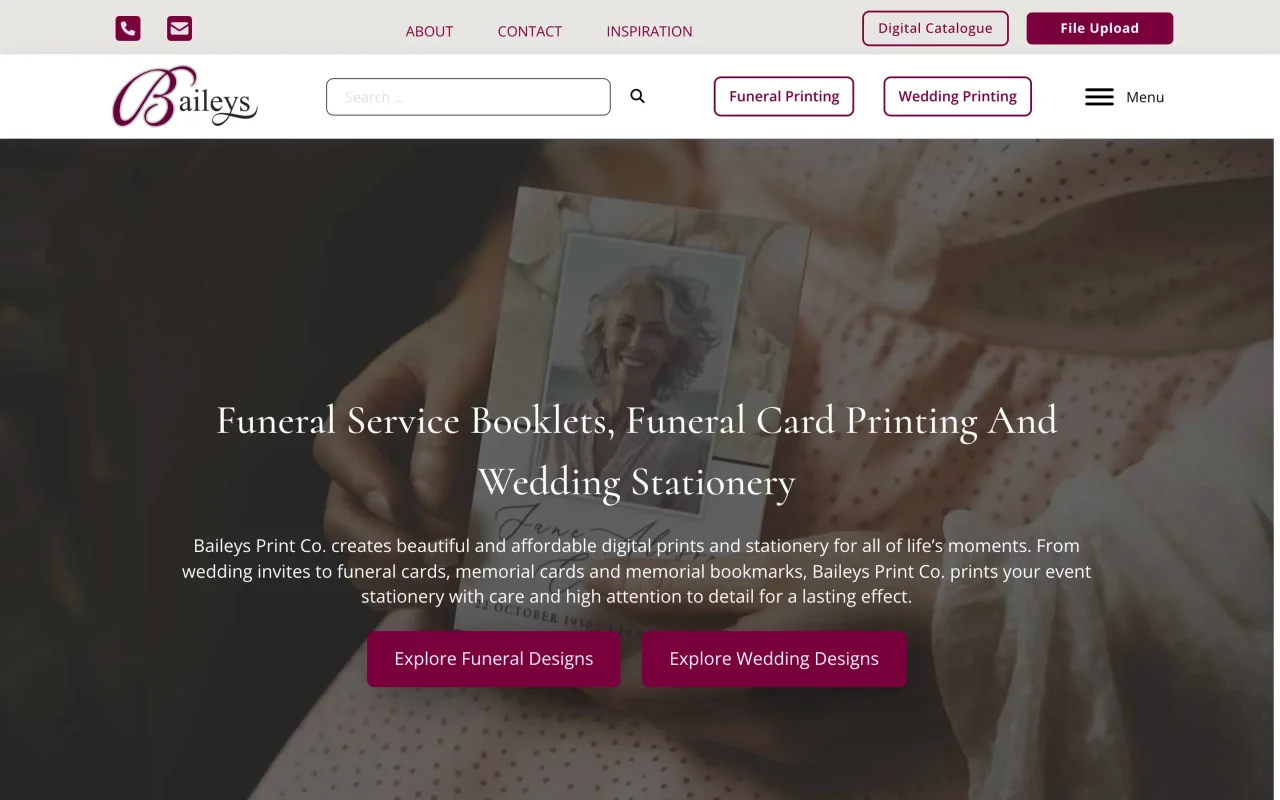

Bailey’s Print Co
Ordering memorial stationery online, at a hard time.
Services: Copywriting, SEO, Website Design
View the projectThe changes
We do the work in step three, through our website, SEO, content writing and copywriting services, or hand the action list to your own team or developer if you would rather keep it in-house. Where several of our services are involved, the shared tasks appear once in one proposal, with an owner and a review date against each.
Every item on the action list traces back to a recorded answer, a cited page or a fact that contradicted another, and the list says where the evidence is thin. Answers vary between runs, so a finding that rests on one answer is marked as such.
The same questions again
The last step is the only honest way to measure movement. We ask the same questions, on the same engines, under the same recorded conditions, and report what moved and what did not. Every website change and every capture gets a date, so a change in the answers can be set against the work that preceded it. Answers vary between runs, which is why each question is asked more than once and why the report says what remains uncertain.
Why does the assistant name a competitor instead of you
This is the question most owners actually want answered, and it has two halves.
The first is who gets named and who gets cited, because they are often different. An assistant might recommend a competitor on the strength of an agency’s listicle, a directory entry or a review site, and never touch the competitor’s own website. Each kind of source needs a different fix, so the audit keeps them apart.
The second is how your page compares with the one that won. When a competitor’s page is cited for a question you should be answering, it goes next to yours. The comparison looks at which questions it answers, how plainly, how much supporting detail it gives and what evidence sits behind its claims. That comparison is usually where the action list comes from.
Know which result you are looking at
The road from a buyer’s question to an enquiry has seven stages, and a business can fall off at any of them.
- Reachable means the assistant’s crawler can get to your pages and read them. This is an eligibility lever. A blocked crawler keeps you out, but an open one does not get you in.
- Retrieved or cited means the assistant pulled your page in while building its answer, whether or not it named you.
- A mention means the assistant named your business.
- A recommendation means it presented you as a provider or option.
- A citation means it linked to your page as a source for its answer.
- A referral visit means someone arrived at your website from an assistant.
- An enquiry means a customer took an action on your site.
Our reports keep these apart, because a business that is reachable but never retrieved has a different problem from one that is mentioned often but never cited, and more mentions do not mean more customers.
Seven stages, kept apart
- Reachable
- Retrieved or cited
- Mentioned
- Recommended
- Cited as a source
- Referral visit
- Enquiry
More mentions do not mean more customers.
Questions about AI Search
Is this the same as SEO?
Both depend on pages the systems can reach and content worth citing. AI Search adds the recorded answers, the comparison against the sources that won and the repeated testing. Each has its own included work, and shared tasks are listed once.
Which assistants are tested?
Before the work starts, we agree with you which engines are available, how many questions to run, which locations to test and how often to report.
Can you get us into ChatGPT?
Nobody can promise that, and we do not. Assistants choose their own answers and sources, and two people asking the same question can get different results. What we can do is record what they say today, find what is holding you back, make the changes and measure the same questions again. The method is repeatable. The recommendation is the assistant’s to give.
Does this need a WordPress site?
No. The measurement works for any website. We make the changes on WordPress, WooCommerce and Shopify sites, or prepare them for your own team or developer, whichever suits your business.
How do we know whether it is working?
The repeated questions and their cited sources show whether the answers moved under the recorded conditions. Referral visits and enquiries add context, and the report says what remains uncertain.
Read more about AI search
-

Edge of Search 2026 and the dog harness that explained modern search
I went to Edge of Search 2026 expecting to learn how SEO changes when people use AI. I came home with a…
-
Some AI Bots Train on You. Others Bring You Customers.
Last week we checked our website’s robots.txt file properly for the first time in a couple of weeks. To our surprise, it…
-
Your Rankings Are Fine. Your Traffic Is Not.
Open Google Search Console and look at your last six months of data. For many businesses, the pattern will be the same.…
Start with where you appear today
Share your website, the services you want to be known for and the customers you want to reach. We will get back to you.