
ChatGPT reads far more than your website. OpenAI says its models are built from public web pages, from information it partners with other companies to access and from what users and trainers provide. Google’s own advice for appearing in its AI answers includes keeping your Merchant Center and Business Profile details up to date, and both of those sit outside your website.
Each of those sources can be checked.
Merchant Center is where a store tells Google which products it wants to show, and a Business Profile is the listing that puts a business on Google Search and Maps. OpenAI sets out its three sources on its help page about how ChatGPT’s models are developed. Google gives its advice on its page about AI features and your website.
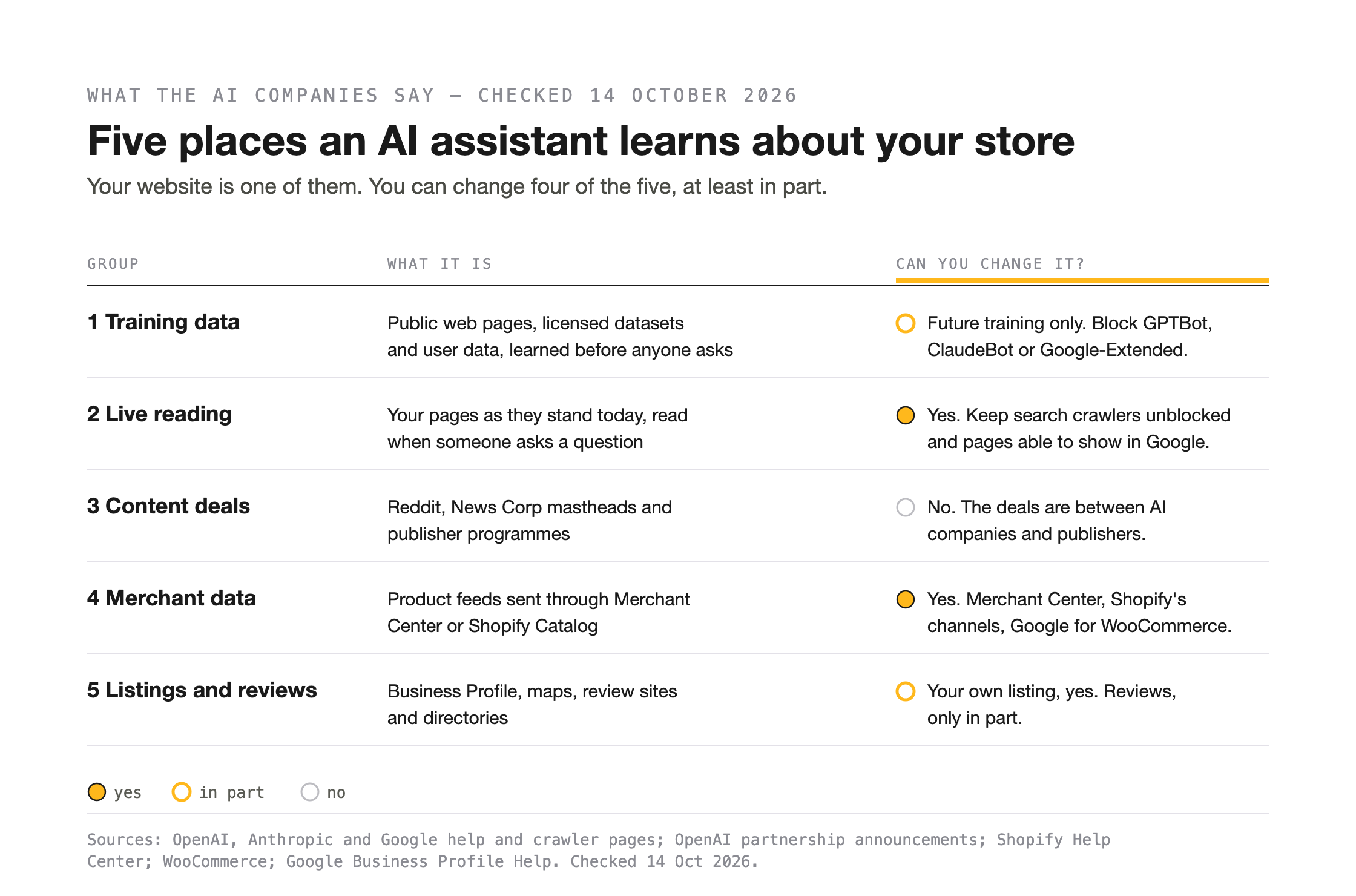
An assistant’s sources fall into five groups. They include what the model learned before anyone asked, what it reads live, what companies get through content deals, what merchants send it, and what listings, maps, and review sites say. We checked each AI company’s page on 14 October 2026, and we quoted OpenAI’s help pages, the merchants page, and Internet Archive copies of announcements dated 8 September to 13 October 2026.
What the Model Learned Before Anyone Asked
Public web pages are only one part of what a model learns from. That material is its training data, the text a model learns from before anyone asks it a question. In Anthropic’s glossary, this first stage is pretraining, where a model is trained on a large body of unlabelled text. Google’s privacy policy says it may collect information “publicly available online or from other public sources to help train Google’s AI models”. Anthropic names more than the web. Its privacy page lists public internet information and “Datasets that we obtain under commercial agreements with third party businesses”, alongside data its users and crowd workers provide.
OpenAI, Google and Anthropic gather the public web part with crawlers. Google defines a crawler as any program that finds and scans websites automatically. OpenAI says its GPTBot crawler collects content that “may be used in training” its models (OpenAI). ClaudeBot, in Anthropic’s words, collects web content that could contribute to training (Anthropic). Google-Extended works differently. It is a name you can use in your robots.txt file (the file that tells crawlers which pages they may visit) to say whether Google may use your content to train future Gemini models, and Google’s page on its common crawlers says it has no effect on your place in Google Search.
Can you change it? Yes, for future training, by blocking the training crawlers in robots.txt. OpenAI says disallowing GPTBot “indicates a site’s content should not be used in training”, and blocking ClaudeBot or Google-Extended asks the same of Anthropic and Google. Our earlier article on which AI bots train on you and which bring you customers covers which ones to allow.
What It Reads Live When Someone Asks
ChatGPT, Claude, Perplexity and Google’s AI answers can all search the web when someone asks a question, so your pages as they stand today can feed what they say. Nathan Gotch, in AI SEO for Dummies, calls this retrieval, where the system “looks up outside information, such as web pages or databases, before it answers a question”.
ChatGPT can decide to search on its own. OpenAI says it “may search the web automatically when your question would benefit from current information”, and that it can use an approximate location from your IP address to give local results (OpenAI). When it searches, ChatGPT “sometimes partners with other search providers”, and its help page links the privacy policies of two of them, Microsoft and Shopify. Google says AI Overviews and AI Mode, the two AI answer features in Google Search, may run “multiple related searches across subtopics and data sources” before answering, and that the two features can show different answers and links (Google). Claude bases its answers on “content from the live web” when it searches (Anthropic). Perplexity searches the internet in real time for each question (Perplexity).
OpenAI, Anthropic and Perplexity each run crawlers for this live reading, and your robots.txt file is where you let their search crawlers in or keep them out. A site that blocks OAI-SearchBot “will not be shown in ChatGPT search answers”, OpenAI says (OpenAI). For Claude, blocking Claude-User or Claude-SearchBot may reduce a site’s visibility in search results (Anthropic). Perplexity’s crawler, PerplexityBot, exists to “surface and link websites in search results on Perplexity” and is not used to train AI models (Perplexity).
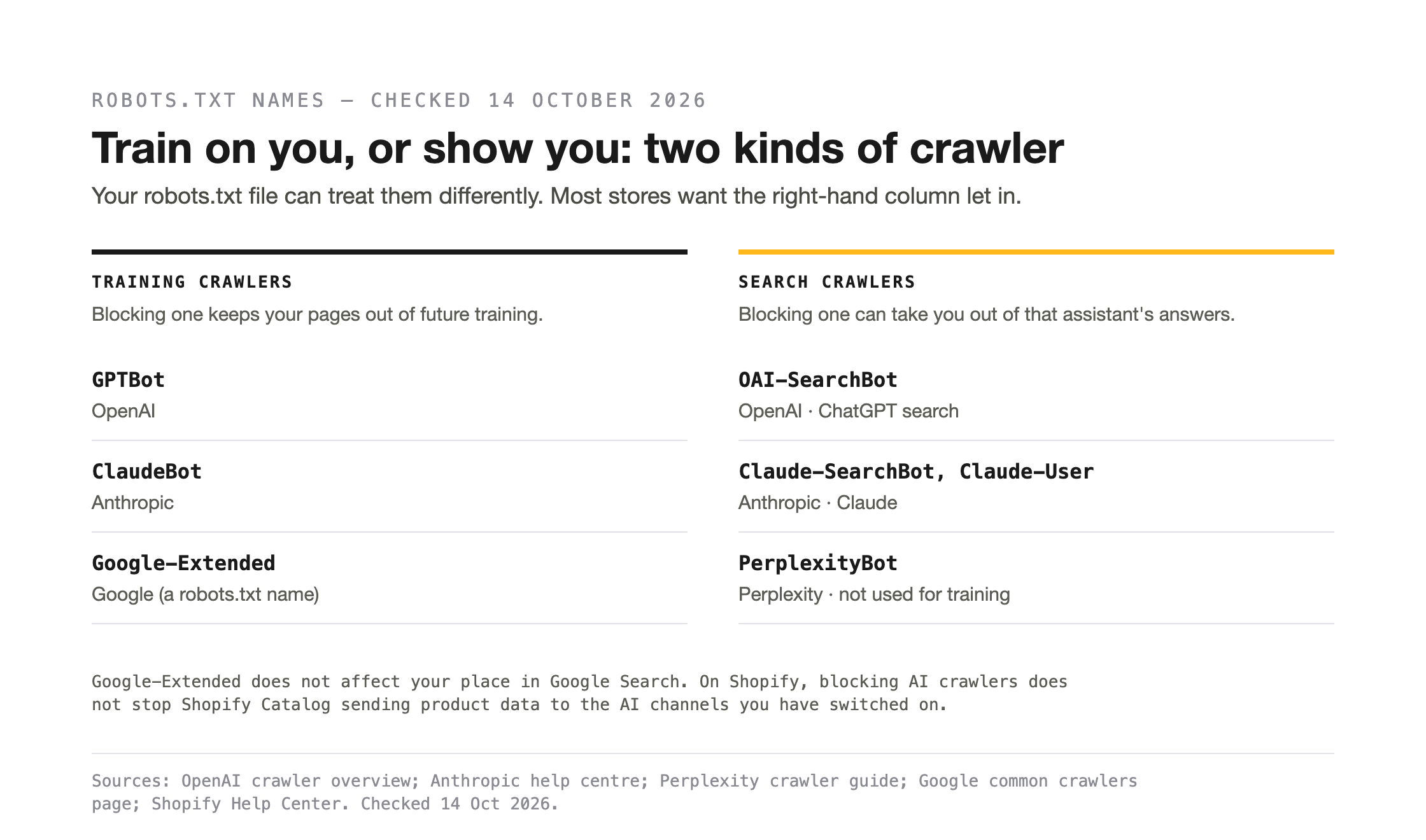
Can you change it? Yes, by keeping those crawlers unblocked and your pages able to show in Google Search. Google says a page can only be a supporting link in AI Overviews or AI Mode if it can already appear in ordinary Google Search with a snippet, the short extract of text shown under a result (Google). On Shopify, blocking AI crawlers in robots.txt affects only reading from the open web. Shopify says it does not stop Shopify Catalog, the system Shopify uses to pass your product data to AI channels, sending that data to the channels you have switched on (Shopify).
What the Companies Get Through Content Deals
OpenAI has announced partnerships that bring Reddit content to ChatGPT and let OpenAI display News Corp content in response to user questions. The Reddit partnership, announced on 16 May 2024, gives OpenAI access to Reddit’s Data API, a structured feed of Reddit content, to “bring enhanced Reddit content to ChatGPT and new products” (OpenAI). Google announced its own Data API access to Reddit on 22 February 2024, saying the access helps it display Reddit content, train on it and use it in other ways (Google).
Closer to home, OpenAI’s multi-year partnership with News Corp, announced on 22 May 2024, gives OpenAI access to current and archived content from mastheads including The Australian, news.com.au, The Daily Telegraph, The Courier Mail, The Advertiser and Herald Sun (OpenAI). OpenAI also says ChatGPT search uses “content provided directly by our partners” alongside third-party search providers (OpenAI). Perplexity announced in July 2024 that publishers in its programme earn a share of what Perplexity makes when their content is referenced. Microsoft announced a pilot marketplace in February 2026 where publishers license content to AI builders, starting with Copilot.
Can you change it? You cannot change the deals. Each one named here is between an AI company and publishers. You can read what a Reddit thread or a story on one of those mastheads says about your store, because the deals cover content from those sites.
What Merchants Send It
Of the AI merchant programmes, Google’s pages are the ones that name Australia. They start with a product feed, a file of your products that you upload to Merchant Center to tell Google which products to show.
OpenAI says ChatGPT uses structured data such as price and product description from “first-party and third-party providers” when it picks shopping results (OpenAI). For Shopify stores, OpenAI says product data already reaches ChatGPT through Shopify Catalog with no extra work. That reach is limited for Australian stores. OpenAI’s merchants page says shopping is currently live for ChatGPT users in the US, and Shopify’s ChatGPT and Microsoft Copilot channels need a store that sells to US customers.
For an Australian store, start by listing your products for free on Google. Google lists Australia among the countries where products can be listed for free on Google, and Shopify says Merchant Center supplies the product data for Google AI Mode and Gemini, so the data and policies there should match your store (Shopify). Once your products are in Merchant Center, its AI performance insights, available for English-language queries on Australian accounts, show how your brand appears in AI Mode and AI Overviews for shopping questions. Google’s checkout feature also covers eligible Australian products from participating merchants, through an early access programme, and Google says shoppers may soon see it in AI Mode and Gemini. For Shopify stores, Shopify says direct checkout in Google AI Mode and Gemini shows only to customers in the US.
Can you change it? Yes. On Shopify, the Google & YouTube app opts your store into showing products for free across Google, and Sales channels > Agentic in your Shopify admin shows which AI channels are switched on (Shopify). On WooCommerce, the Google for WooCommerce extension syncs your catalogue to Merchant Center (WooCommerce). Our view is that Merchant Center and your Business Profile are where an Australian store should start, because Google’s AI answers page names both and its merchant programmes name Australia.
What Listings, Maps and Review Sites Say
Your Business Profile is the first listing to check, because Google’s AI answers page tells site owners to keep it up to date. A business listing is the profile a map or directory shows for your business, with its name, address, hours and reviews. To show on Search and Maps, you must add or claim your business and verify your Business Profile. You can then edit the verified profile to keep your address, hours and contact details accurate (Google).
For developers building on Gemini, Google documents a way to draw on Maps. Its Gemini API documentation says the Grounding with Google Maps service queries Google Maps for places, reviews, photos, addresses and opening hours. Google’s Ask Maps lets people ask Maps questions about places using Gemini. It began rolling out in Australia on 7 August 2026 (Google Australia).
In ChatGPT shopping, product review summaries are written by the model from “reviews from public websites”, and OpenAI does not verify those reviews (OpenAI). In Google’s Product Ratings programme, the stars combine ratings from merchants, review sites, sites that gather other sites’ reviews and Google users (Google). OpenAI, Google and Anthropic do not name the review sites or directories their assistants read. The practical list comes from asking the assistant itself.
Can you change it? You can change your own business listing, and Google also lets you suggest edits to a Business Profile you don’t manage. You can change reviews only in part. Google says only reviews that break its policies can be removed, and that it does not step into disputes between a business and its customers. It also says reviews from other sites might show on your profile (Google).
How to See Where an Answer Came From
ChatGPT, Google, Perplexity, Claude, and Copilot Search all show the pages behind an answer that used web search, and those pages are your sources to check. In ChatGPT, select a citation to open its source, or select Sources to see the cited pages and other links. OpenAI adds that results and citations can be incomplete, out of date or wrong (OpenAI). Google shows links to supporting websites with AI Overviews and AI Mode answers (Google), and Perplexity numbers each citation and links it to the original source (Perplexity). Anthropic says every Claude response that uses web search includes citations (Anthropic). Microsoft said in April 2025 that Copilot Search in Bing lists every link used to build an answer. That covers the search page, not every Copilot product (Microsoft).
An answer drawn from training data can appear with no sources. Gotch notes that when an answer is simple and well covered in training data, the model can respond without looking anything up, and “you often don’t see citations”. So asking the assistant directly where its description came from is still worth doing.
For Copilot, Microsoft’s AI Performance report in Bing Webmaster Tools, announced as a public preview on 10 February 2026, shows how often your site is cited in Copilot and Bing’s AI summaries, with the cited addresses (Microsoft).
Check One Assistant, Then Fix Each Source
Start with one assistant and one question. Ask ChatGPT, Gemini or Copilot to describe your store and to say where that information came from. Then work through what it names:
- Open each source it lists, whether a business listing, a review site, a marketplace or a forum thread, and check your store’s name, address, products and claims against what is true today.
- Keep your name, address and phone number identical everywhere they appear. Tommy Shirley, in his book on local SEO with Google Maps, calls this NAP consistency.
- Edit your Business Profile wherever it is wrong.
- Correct your feed in Merchant Center so prices, stock and return policy match your store.
- Update the page on your own site, because that is what live search reads.
Correcting a source does not mean the next answer will change, because AI answers vary from one run to the next. Rankings, sales and AI recommendations are never guaranteed.
To see this across multiple assistants, ask for our free AI Search report. It asks 50 buyer questions of five AI tools (ChatGPT, Gemini, Microsoft Copilot, Google AI Overviews and Google AI Mode) and records every answer and every source. It is the first step of our four-step method, followed by what is holding your store back, the changes and the same questions asked again. We typically respond within one business day.
References
- OpenAI, “How ChatGPT and our foundation models are developed”, Help Center, Internet Archive capture of 7 October 2026. https://help.openai.com/en/articles/7842364-how-chatgpt-and-our-foundation-models-are-developed
- OpenAI, “Overview of OpenAI Crawlers”. https://developers.openai.com/api/docs/bots
- OpenAI, “Searching the web with ChatGPT”, Help Center, capture of 23 September 2026. https://help.openai.com/en/articles/9237897-chatgpt-search
- OpenAI, “Shopping with ChatGPT Search”, Help Center, capture of 16 September 2026. https://help.openai.com/en/articles/11128490-shopping-with-chatgpt-search
- OpenAI, ChatGPT merchants page, capture of 3 October 2026. https://chatgpt.com/merchants
- OpenAI, “OpenAI and Reddit Partnership”, 16 May 2024, capture of 13 October 2026. https://openai.com/index/openai-and-reddit-partnership/
- OpenAI, “A landmark multi-year global partnership with News Corp”, 22 May 2024, capture of 8 September 2026. https://openai.com/index/news-corp-and-openai-sign-landmark-multi-year-global-partnership/
- OpenAI, “Introducing ChatGPT search”, 31 October 2024, capture of 2 October 2026. https://openai.com/index/introducing-chatgpt-search/
- Google, Privacy Policy, effective 1 October 2026. https://policies.google.com/privacy
- Google Search Central, “Overview of Google crawlers and fetchers”. https://developers.google.com/search/docs/crawling-indexing/overview-google-crawlers
- Google Search Central, “Google’s common crawlers”. https://developers.google.com/search/docs/crawling-indexing/google-common-crawlers
- Google Search Central, “AI features and your website”. https://developers.google.com/search/docs/appearance/ai-features
- Google Search Central, “Share your product data with Google”. https://developers.google.com/search/docs/specialty/ecommerce/share-your-product-data-with-google
- Google, “An expanded partnership with Reddit”, 22 February 2024. https://blog.google/company-news/inside-google/company-announcements/expanded-reddit-partnership/
- Google Merchant Center Help, “Show your products for free on Google”. https://support.google.com/merchants/answer/13692890?hl=en
- Google Merchant Center Help, “About AI performance insights”. https://support.google.com/merchants/answer/17200695
- Google Merchant Center Help, page on the Universal Commerce Protocol (UCP) checkout. https://support.google.com/merchants/answer/16837055
- Google Merchant Center Help, “Product Ratings basics”. https://support.google.com/merchants/answer/6059553?hl=en
- Google AI for Developers, “Grounding with Google Maps”. https://ai.google.dev/gemini-api/docs/maps-grounding
- Google, “Ask Maps and Immersive Navigation”, 12 March 2026. https://blog.google/products-and-platforms/products/maps/ask-maps-immersive-navigation/
- Google Australia, “Ask Maps is rolling out in Australia”, 7 August 2026. https://blog.google/intl/en-au/products/explore-get-answers/ask-maps-australia/
- Google Business Profile Help, “Edit your Business Profile”. https://support.google.com/business/answer/3039617?hl=en
- Google Business Profile Help, “Report inappropriate reviews on your Business Profile”. https://support.google.com/business/answer/4596773?hl=en
- Anthropic, Claude Docs glossary. https://platform.claude.com/docs/en/about-claude/glossary
- Anthropic Privacy Center, “How Do You Use Personal Data in Model Training?”, 16 March 2026. https://privacy.claude.com/en/articles/10023555-how-do-you-use-personal-data-in-model-training
- Anthropic Help Center, “Does Anthropic crawl data from the web, and how can site owners block the crawler?”, 7 April 2026. https://support.claude.com/en/articles/8896518-does-anthropic-crawl-data-from-the-web-and-how-can-site-owners-block-the-crawler
- Anthropic Help Center, “Enabling and using web search”. https://support.claude.com/en/articles/10684626-enabling-and-using-web-search
- Perplexity Help Center, “How does Perplexity work?”. https://www.perplexity.ai/help-center/en/articles/10352895-how-does-perplexity-work
- Perplexity Docs, “Perplexity Crawlers”. https://docs.perplexity.ai/guides/bots
- Perplexity, “Introducing the Perplexity Publishers’ Program”, 30 July 2024. https://www.perplexity.ai/hub/blog/introducing-the-perplexity-publishers-program
- Microsoft Advertising, “Building toward a sustainable content economy for the agentic web”, 3 February 2026. https://about.ads.microsoft.com/en/blog/post/february-2026/building-toward-a-sustainable-content-economy-for-the-agentic-web
- Microsoft Bing Blog, “Introducing Copilot Search in Bing”, 4 April 2025. https://blogs.bing.com/search/April-2025/Introducing-Copilot-Search-in-Bing
- Microsoft Bing Webmaster Blog, “Introducing AI Performance in Bing Webmaster Tools Public Preview”, 10 February 2026. https://blogs.bing.com/webmaster/February-2026/Introducing-AI-Performance-in-Bing-Webmaster-Tools-Public-Preview
- Shopify Help Center, “Shopify agentic storefronts”. https://help.shopify.com/en/manual/online-sales-channels/agentic-storefronts
- Shopify Help Center, “Selling on ChatGPT”. https://help.shopify.com/en/manual/online-sales-channels/agentic-storefronts/chatgpt
- Shopify Help Center, “Selling on Google AI Mode and Gemini”. https://help.shopify.com/en/manual/online-sales-channels/agentic-storefronts/google
- Shopify Help Center, “Selling on Microsoft Copilot”. https://help.shopify.com/en/manual/online-sales-channels/agentic-storefronts/microsoft
- Shopify Help Center, Shopify Catalog page for agentic storefronts. https://help.shopify.com/en/manual/online-sales-channels/agentic-storefronts/products
- WooCommerce, “Agentic Commerce”. https://woocommerce.com/agentic-commerce/
- Nathan Gotch, AI SEO for Dummies (book).
- Tommy Shirley, book on local SEO with Google Maps.
- Duelling Pixels, “Some AI Bots Train on You. Others Bring You Customers.”, 28 July 2026. https://duellingpixels.com/blog/business-online/some-ai-bots-train-on-you-others-bring-you-customers/
- Duelling Pixels, AI Search Optimisation & GEO, new site build, 21 October 2026. https://duellingpixels.com/ai-search-optimisation/

Leave a Reply