
Newcastle, 3 and 4 September 2026
The example that made the conference click for me was a Reddit thread about a dog harness. A UK owner had asked which one to buy, a Julius or a Perfect Fit. Commenters recommended a third brand, Bully Billows, that the thread owner hadn’t mentioned. Ashley Liddell used it in the closing talk to make two points. That thread also appeared as a Google result. The same brand had been tagged days earlier in a TikTok of a nervous dog trying on a harness.
Nobody in that chain typed “best dog harness” into Google. The discovery happened in a feed, the comparison happened in a forum, and Google’s job, if it had one, was to confirm the shop’s address at the end. Every speaker over the two days described a version of that chain from a different angle.
Last week, I went to Edge of Search expecting to learn more about how SEO changes when people use AI. I came home with three things instead. Search engines and AI models now work in entities, and a brand is one of them. Search happens across feeds, forums, socials and AI answers, with the website as the source behind them all. And the way we measure any of it has to change, because a ranking no longer describes the outcome.
From keywords to entities
I recorded a voice memo on the way back to the hotel after the first day, and the first line was “keywords out, entities in”. It overstates the case, but it was the thing I most needed to remember. While I knew keywords were no longer the item to measure and watch, what replaced them?
Nik Ranger’s technical masterclass had spent an afternoon on one medical website, a 75-page audit she had done for a large clinic. The example that stuck was a single diagnostic test, a mammogram, that the site described on nine separate URLs left over from two migrations. Google copes with that. It picks one page as canonical and ranks it. A language model has no concept of a primary version. It sees nine pages about the same thing and either picks one at random or gives up. Her rule of thumb from that audit was that any topic on more than three URLs needs consolidating, and anything on more than seven is what she called a starburst.
That is what “entity” means in practice. A mammogram is an entity. So is a brand. The model holds a map of how they connect, and the site’s job is to make that map unambiguous.
Her Friday session showed the same idea from the outside, using a brand that sells Instagram and TikTok growth tools. She had asked a model the same topic prompt 30 times and counted how often the brand came up. For “instant versus gradual delivery followers”, it appeared 29 times out of 30. For “buy TikTok followers”, which is the product the company sells, it appeared zero times out of 30. The model knew the brand for its free calculators and downloaders and had no association with the commercial category at all. That gap is the work, and no rank tracker would have found it.
Where a model’s knowledge of a brand comes from
Nik’s Friday session traced how a query becomes an answer, and one fork in that process explains a great deal. Before a model answers, it decides whether to search the web or to answer from memory. She called the memory route parametric and the search route grounded.
The team at DejanSEO has published a free classifier on Hugging Face, Query Demands Grounding, that predicts which route a query will take. Her example was “what colour is the sky”. Gemini searches the web for that. It searches for almost everything. ChatGPT searches for roughly 91 to 95% of queries and Claude for somewhere between 78% and 92%, depending on industry. She made it clear this reflected the data she was seeing.
The fork matters because a model has only two ways to know a brand exists. The first is the memory route. A brand that appears in an answer without any web search has been included in the model’s training data, and Luke Gosha explained what that involves. A model is trained on a fixed set of data with a cut-off date, so anything a business wants recalled has to be in the public record before that date. The second is the search route, and for that the brand has to rank in ordinary search, because the model’s live retrieval is built from what it can fetch. The Instagram tools brand above had made it into training for its free calculators and downloaders. For the product it sells, the model had no memory of it.
Where does the training data come from? Mostly from crawls of the public web, either the lab’s own crawler or Common Crawl, whose crawler is CCBot. On top of the crawl sit licensed sources. Reddit has signed data deals with both Google and OpenAI, which is one reason the harness thread counts twice, once as a search result and once as material a model can learn from.
Not everything said about a brand reaches that pool. Facebook, Instagram, and TikTok sit behind logins, and the platforms decide who may crawl them. A recommendation in a Reel or a group chat happens, and no model learns from it. To a model, a brand that is well loved on Instagram and absent from the open web is a brand without evidence.
That leaves the website as the one part of the record a business controls, and it only counts if a machine can read it. AI crawlers fetch raw HTML and do not run JavaScript, so anything that loads by script is invisible to them. Nik showed this on the medical site by crawling it with JavaScript off. A third of the pages lost their structured data entirely, and what remained described each entity without connecting it to any other. Her fix was one clear source of truth per entity, linked to the next, in the server-rendered page. That is the whole technical brief for AI search. Publish the information once, in a form a machine can follow.
Somebody has to own the website’s plumbing
Sally Mills argued that most of what gets filed under SEO is website plumbing the business needs whether or not Google exists, and in most organisations nobody owns it. Bot management, log files, whether JavaScript renders for the crawlers that matter, redirects years after a migration, site-wide 404s, and accessibility in the markup.
Design, content, and paid media each have a name. This list of infrastructure and housekeeping jobs does not, and we see the same gap in our own clients’ organisations. Most have heard of log files and robots.txt and know a migration needs redirects. Fewer could say what those things do, who last looked at them, or what happens to the business when they go wrong. The work falls to whoever last touched the website, which in a small business is often nobody.
Her reframe was to call each job what it is to the business. Page speed is conversion rate. Redirects are every link in every email and brochure the business has ever sent. Headings and alt text are what a screen reader depends on, and fixing the screen reader fixes the bot.
AI adds urgency. Cloudflare’s data on the top 10,000 domains shows around one in eight blocking GPTBot and ClaudeBot completely, and Sally’s point was that most of those blocks are hosting or CDN defaults nobody chose.
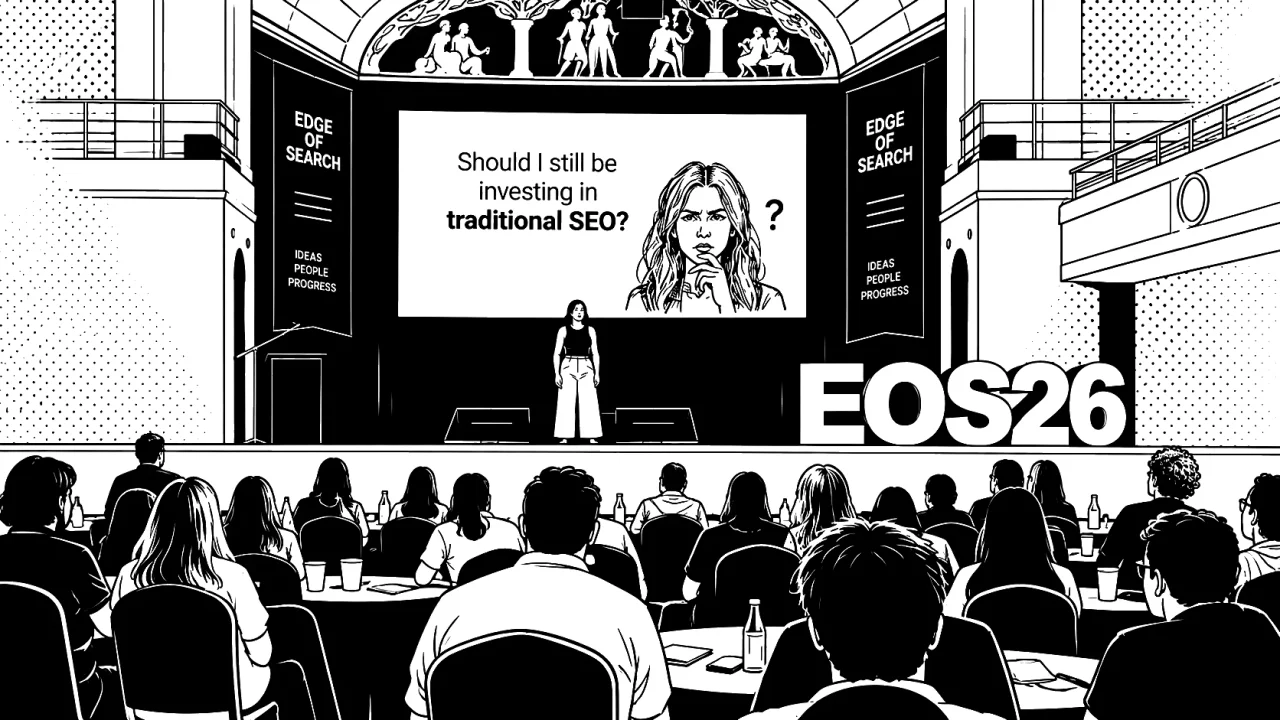
Most of the evidence lives off the website
Whether a brand appears in an AI answer depends first on the question type. Robbie Richards from Virayo showed two chats side by side. The first asked what to do after a car accident, the model gave general advice and named no law firm. The second asked for the best test management tools for a team on Jira, it named three products and cited a source for each. Informational questions get an answer. Recommendation questions get brand mentions, and those are the only answers a business can win or lose.
He then mapped where those answers came from. For one client selling corporate giving software, ChatGPT drew on 48 domains and Claude on 65. ChatGPT leaned on G2, Capterra, and Gartner. Claude’s list was mostly small corporate blogs, and Robbie had marked several with arrows because the client had never heard of them. The brand’s own website was one source among dozens.
Nik’s citation mining showed the same thing for SMS marketing. Across thousands of prompts, ChatGPT’s most-cited domain was Twilio, followed by the FCC and Cornell’s legal archive. Gemini’s top three were all vendor websites. The list of places a brand needs to be mentioned differs by engine, and the only way to find it is to run the prompts and count. Internally, I have been building Barking Owl AI as an Australian AI visibility tool to track brand mentions in AI answers.
Luke Gosha showed what earns a place on those lists. When he asked ChatGPT for the best blue-light sunglasses in Australia, it named an Australian brand as its pick and gave reasons lifted straight from that brand’s product page. The product page, its reviews, and the shopping feed behind it were doing the work. Luke Gosha’s test for content value was whether only one business could have written it. A generic guide to choosing running shoes is a commodity, and in his view, commodity content no longer earns a place in the index. A shop’s own analysis of why a customer’s shoes failed at 400 miles is the kind of piece that might.
How one question becomes six, and what fan-out means for content
When a model answers a recommendation question, it doesn’t run a single search. It breaks the question into several of its own and searches for each; this is called a fan-out. His example was “best test management tool for a team already on Jira”, which the model split into six smaller questions, including whether the Jira sync is two-way, what it costs on top of Jira, and how it compares with the Zephyr plugin.
This changes what content is for.
Each of those six questions is answered best by a particular kind of page, an integration page, a pricing FAQ, a head-to-head comparison, and the brand that has those pages is the one the model can cite. It also explains why comparison content keeps appearing in the sources behind AI answers. People still want to weigh two options before they act, and the model goes looking for a page that does the weighing.
People are becoming entities too
Despina Gavoyannis took the entity idea somewhere else. What if the entity is the person searching?
She quoted Google from 2016 saying, in its own words, that its ability to understand documents directly was minimal, so it watches how people react to them and memorises the reactions. Ranking has been audience modelling for a decade. AI search pushes it further. Google Research’s USER-LLM work compresses a person’s whole interaction history into an embedding, the same kind of object used to represent a webpage. It feeds it to the model before it answers. The model carries who is asking along with what was asked.
Her example of a person as several entities was Arnold Schwarzenegger. Politician, bodybuilder, actor. Which one is relevant depends on the question, and the same is true of a searcher. So the useful persona is built on intent, tastes, and actions, and my shorthand from the day was “optimise for people patterns”. Her last point is the one I keep returning to. Encourage customers to save your brand in their AI’s memory. She called it FYP optimisation for ChatGPT.
The feed is a results page
Jes Scholz compared what Google can read from each video format. For long-form YouTube, it reads everything, including chapters and the transcript. For Instagram Reels, it reads the title, description, hashtags, and thumbnail, and nothing that was said aloud. Whatever is said aloud in a Reel is invisible to Google unless it also appears in the caption. Same video, different surface, different amount of it that an AI machine can read.
Ashley Liddell’s closing talk took that further. The For You Page on TikTok already does what a search engine does. Someone has a need, the platform infers it, a ranking system produces candidates, and the person watches, saves, or moves on. YouTube comments and Reddit threads work the same way, and the harness thread was his proof. He argued that Google is becoming more like the feed, conversational and answer-first, and that the work splits accordingly. Feeds and forums handle discovery and comparison. Google keeps verification, navigation, and the purchase.
A mention is no longer enough to measure AI visibility
Nik’s measure splits visibility into mention share, how often a brand is named in AI answers, and citation share, how often its website is linked. Her example brand sat at 1.47% and 0%. It was named occasionally and never linked, and those two numbers said more about its position than any ranking report.
Robbie added the four ways a mention can still be a loss. The facts can be wrong. The framing can be hedged. The brand can be buried under competitors. Or the website can be cited as a source without naming the brand at all. One of his clients had a 78% mention rate and seven inaccuracies in the same month.
His most useful evidence compared GA4’s count of AI leads against a form field that asked customers how they found the business. Every month the form number was roughly double. In August, GA4 showed 9, and the form showed 18. Three speakers gave the same advice independently. Add “AI search” to “how did you hear about us?”, because many AI answers are read without a click, and the click that does come often carries no referrer.
Ashley’s answer to the same problem was share of search, the brand’s slice of all branded searches in its category, tracked per platform. He described the chain that happens without it. Last-click attribution shows brand and direct traffic driving the pipeline. PR, social, and AI work look inefficient and get cut. Brand search volume decays about three months later. Pipeline drops, and nobody can explain why. Brand search is an output of everything the business does, and reporting it solely as an SEO win hides that.
Business context changed Brogan’s answer completely
The morning before Nik’s masterclass, I sat in Brogan Renshaw’s session on Claude Code for marketers, run through Firewire Digital. It used a fictional Newcastle dental practice with two months of Search Console and Google Ads exports, and it described, closely enough to be uncomfortable, how we already work at Duelling Pixels. Client context in a plain-language brief, monthly jobs saved as commands that read the brief before they read the data, and a person checking every output before it leaves the studio.
The same five files were analysed twice. The first run, with no brief, ranked the opportunities by how big each gap looked. The largest was an emergency dentist page modelled at 38 extra bookings a month. The second run had the brief, and nothing else had changed. The emergency page dropped to third, because the practice caps at 180 bookings a month and was already taking 171. An opportunity you cannot serve is a waiting list.
That is the lesson I took from the whole morning. An analysis without business context is a description. The context is the knowledge that usually sits in one person’s head, and writing it down once is most of the work.
AI visibility will never behave like a clean rank report
Daniel Cheung gave the shortest and most quotable talk of the day, on what “good enough” means in enterprise SEO. Good enough, he said, is not the easy route and not what the client wants to hear. It is actionable, problem-specific advice delivered before perfection gets in the way of progress.
His own case was a blog whose traffic had fallen for years. The first question he asked was whether the lost traffic mattered. It had not. The drop was a symptom of a stale content strategy, so he built a small, reversible fix by hand, automated only the steps that proved out, and reported the limitations alongside the results.
That posture fits AI visibility because nothing about how the machines read a website is regular. Googlebot arrives on a schedule the site has earned, and Nik’s log-file work kept turning up bots entering through pages nobody expected, parameter URLs, retired hostnames, and pages deleted a year ago. The AI crawlers are less predictable again. They fetch a fraction of what Googlebot does, follow one or two redirects where Google will follow ten, and skip anything that needs a script to render. Whether a model searches at all depends on the model, the industry, and the question, and when it does, each model reads from its own set of sites and cites them at different rates.
Luke Gosha’s month-long test made the point best. He published a markdown version of a site for AI crawlers to read. Over a month, Meta’s bot fetched it nine times, Googlebot twice, and no OpenAI, Anthropic, or Perplexity crawler came at all. The theory was plausible. The crawlers never came, and no report would have predicted which ones did.
So the same prompt returns a different answer on Tuesday, and a brand’s share of AI answers moves for reasons no single site change explains. Ashley Liddell’s advice was to treat citation share as something you watch continuously, never as a number you screenshot once and put in a strategy document.
Search now reaches far beyond the results page
I went to Newcastle expecting to learn how SEO changes when people use AI. What I came home with was a bigger question about where search happens now.
Go back to the harness. The owner didn’t start with Google, and the brand that won wasn’t the one with the best-ranked product page. It won because evidence about it sat where people and machines looked. A Reddit comment, a TikTok tag, a product feed, and a website with the right details to confirm it all when someone finally checked.
For me, that is the useful way to think about search after Edge of Search. The website is still the foundation, because it holds the business’s own account of itself. What has changed is the unit the machines work in. Keywords and rankings describe a page. Entities describe the business, its products and services, its people, and the markets it operates in, and a model builds its picture of a brand from those. They now sit inside a much larger system of brand, reputation, evidence, feeds, communities, and AI answers, and the marketing job is to make sure it all tells the same story.
A final thank you to the Edge of Search team for putting together two days that were genuinely useful, practical, and full of ideas worth taking back to the real work. In particular, thank you to Brogan Renshaw, Shonavee Simpson-Anderson, and Ashley Silver for the work that went into making the event happen and creating an environment where speakers, practitioners, and attendees could compare notes on where search is heading next.

Leave a Reply