
Shopify and WooCommerce both tell store owners to get their product data ready for AI shopping assistants. Shopify calls that work GEO. WooCommerce calls it AEO. It’s the same job under two names.
Elsewhere the names are just as mixed. The 2023 research paper that introduced GEO, or generative engine optimisation, focused on website text, and Semrush uses AI SEO to mean doing search engine optimisation (SEO) with AI tools, which is a different job. For a store, the work comes in three parts, and Google’s guide to generative AI search covers all three. They are product data such as Merchant Center feeds, website pages, and off-site reputation, which is what is said about your products across the web. The name on a quote tells you little. The list of work under it tells you what you are buying.
Where each name came from
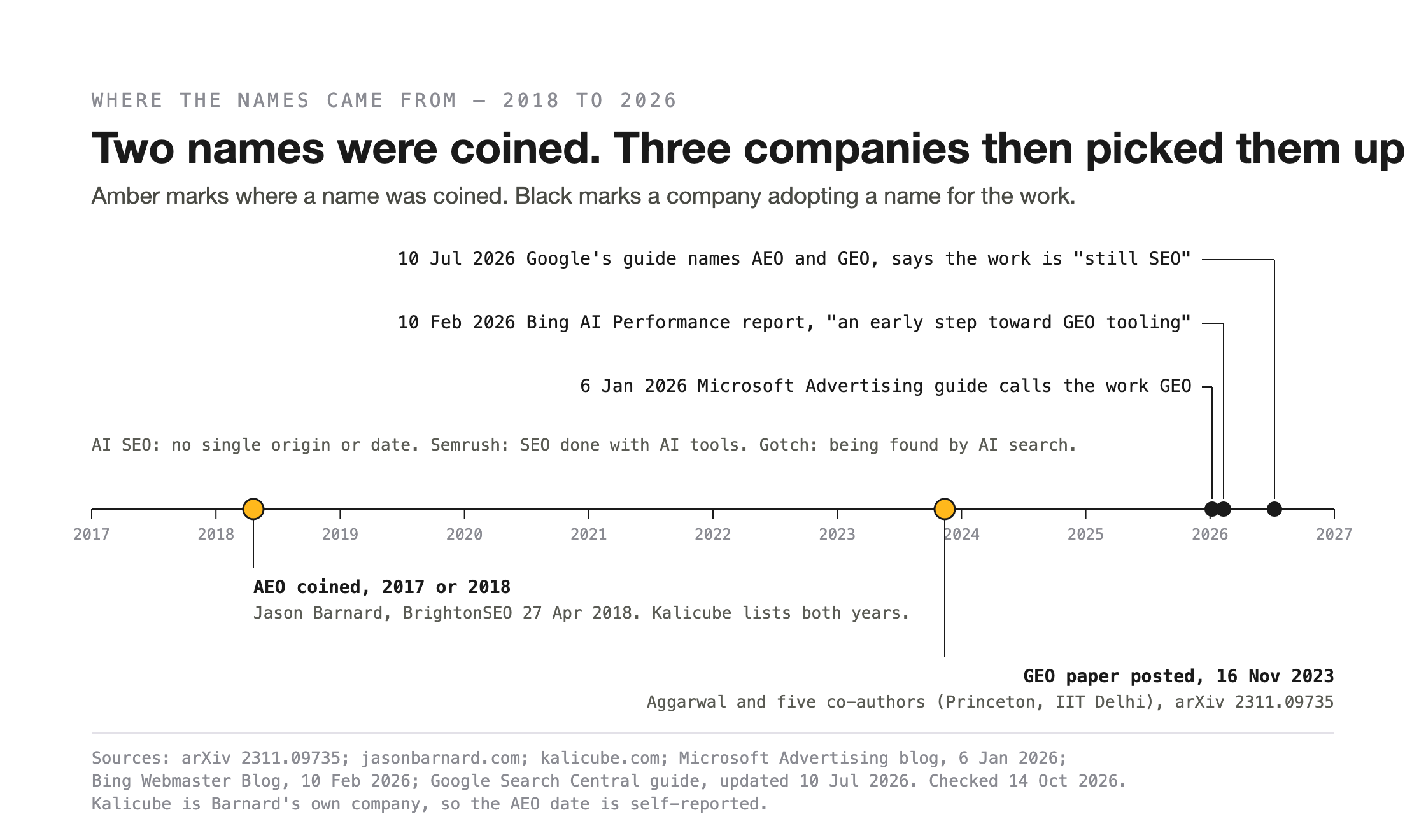
The three names come from different places, and each meant something different from the start. GEO has the clearest origin. Pranjal Aggarwal and five co-authors, from institutions including Princeton University and the Indian Institute of Technology Delhi, posted the paper online on 16 November 2023. They described GEO as a way for content creators to increase their visibility in generative engine responses. The paper calls these generative engine systems BingChat, Google’s SGE, and Perplexity, which search several sources and write one answer from them.
The authors tested methods that change the text on a page, such as adding quotations, statistics, and references to credible sources. Their tests used general questions, so the paper says nothing direct about product pages. The same three letters have since picked up other meanings. Eric Enge and Adrian Ridner, in their 2025 O’Reilly book Using Generative AI for SEO, describe GEO as getting your page included as one of the reference links in Google’s AI-generated answers. Shopify uses GEO for optimising product data for AI agents.
Answer engine optimisation has been in use since about 2018. Perplexity’s help page puts the term in a heading, “What is an answer engine and how does Perplexity work?” Jason Barnard’s site says he, the founder of Kalicube, gave a talk on answer engine optimisation at BrightonSEO on 27 April 2018, and Kalicube’s glossary lists both 2017 and 2018 as the year he coined the term. Today, HubSpot, which sells AEO tools, defines AEO as “all the motions used to improve citations and mentions in answer engines”. A citation is a source shown inside an AI answer. HubSpot also writes, “The terms AEO and GEO are often used interchangeably. But they are different, despite some overlap.”
AI SEO has no single source and two meanings. Mangools, a tool vendor, uses it for both at once, using AI to do your SEO and being found by AI search. Semrush uses it only for the first, “using AI tools to improve and streamline the SEO workflow”, and treats being cited by AI search as a separate step. Nathan Gotch, in AI SEO For Dummies (Wiley, 2026), uses it only for the second, making a brand easier for AI search systems to find, trust, cite and include in answers. If a quote says AI SEO, it is fair to ask which of the two you are being offered.
What Google, Microsoft and the AI companies call it
The companies that run the assistants also don’t settle the question. Google names both AEO and GEO in its July 2026 guide to generative AI search as terms you may see used, then says that from Google Search’s point of view the work is “thus still SEO”. Its page on AI features says there are no additional requirements and no special optimisations needed to appear in AI Overviews or AI Mode, its AI features in Search.
Microsoft goes the other way and calls the work GEO. Microsoft Advertising’s January 2026 guide to GEO says “SEO is how you won in search” and GEO is how you win the recommendation from AI. It says three kinds of data determine whether a business gets seen, listing them as “feeds, crawled data, and offsite data”. In Google’s words, a crawler is any program that automatically scans websites. Microsoft also has an AI Performance report in Bing Webmaster Tools, a service Microsoft says has long helped website owners understand their search performance. The report, in public preview since February 2026, counts how often a website is shown as a source in AI-generated answers. Microsoft calls it “an early step toward Generative Engine Optimization (GEO) tooling”.
OpenAI, Anthropic and Perplexity use none of the three names on their help pages about search, as of 14 October 2026. Instead, these companies describe the result from the shopper’s side. OpenAI says ChatGPT search answers “with current information and links to relevant sources”. Anthropic says every Claude response that uses web search includes citations. Perplexity says each answer includes numbered citations linking to the original sources.
Our view is that the three names point at one aim, being found and named by AI assistants, and that they differ more in who uses them than in the work. Mangools says the labels “all describe different parts of the same shift”, and Gotch writes in AI SEO For Dummies that “there is no strict industry standard yet”.
For a store, the work comes in three parts
Each of the three parts lives somewhere different: in your product feed, on your pages, and on other sites. Our earlier article, SEO vs AEO, covers how small businesses can be named in an AI answer. This one stays with stores and products.
Product data is the first part. It is your product feed plus the structured data on your product pages. A product feed is the file of your products, each with attributes such as price and availability, that you add to Google Merchant Center, the Google service for showing your products on Google. Structured data is, in Google’s words, a standardised format for giving information about a page. On a product page, it lets Google show price, availability, review ratings and shipping right in the search results.
Google says Merchant Center feeds can help your products be visible in its AI responses, and its conversational attributes let retailers rewrite product descriptions for the more conversational way people now search. OpenAI says ChatGPT’s product results draw on structured metadata such as price and product description. WooCommerce, which calls this work AEO, puts Merchant Center feeds and product data fields under structured data too, information it says is “made for machines to read directly”.
For an Australian store, Google names Australia on its product data pages. Its Merchant Center AI performance insights, which report how visible your products are in Google’s AI shopping results, are available now to Merchant Center accounts in Australia, for English-language searches. Google said in May 2026 that checkout inside its AI shopping features would reach Australia in the coming months, and in September that the Merchant Center tools for it follow early next year.
Shopify and OpenAI name only North American countries. Shopify says purchasing through AI channels is currently available only to US buyers, and OpenAI’s product feed specification lists only the US, Canada, and Mexico.
Website pages are the second part, and they are what the GEO paper studied. For online stores, Nathan Gotch writes in AI SEO For Dummies, category pages help shoppers compare groups of products and product pages answer the final questions before someone buys. Google Search Console, where Google reports how your site performs in search, shows how those pages perform in Google’s generative AI performance report, rolled out to all websites by 31 August 2026. For ChatGPT, the question is access. OpenAI says a site that allows its search crawler, OAI-SearchBot, can appear in ChatGPT search results. Any provider should be able to confirm whether your site allows it.
Off-site reputation is the third part. Blogs, videos and forum discussions all count, because Google says its AI features can show what is being said about products across the web in them. HubSpot puts PR, partnerships, social and outside publishing inside AEO for the same reason, and Gotch calls the result off-site consensus, meaning reviews, profiles, directories and press mentions that back up what your own site says.
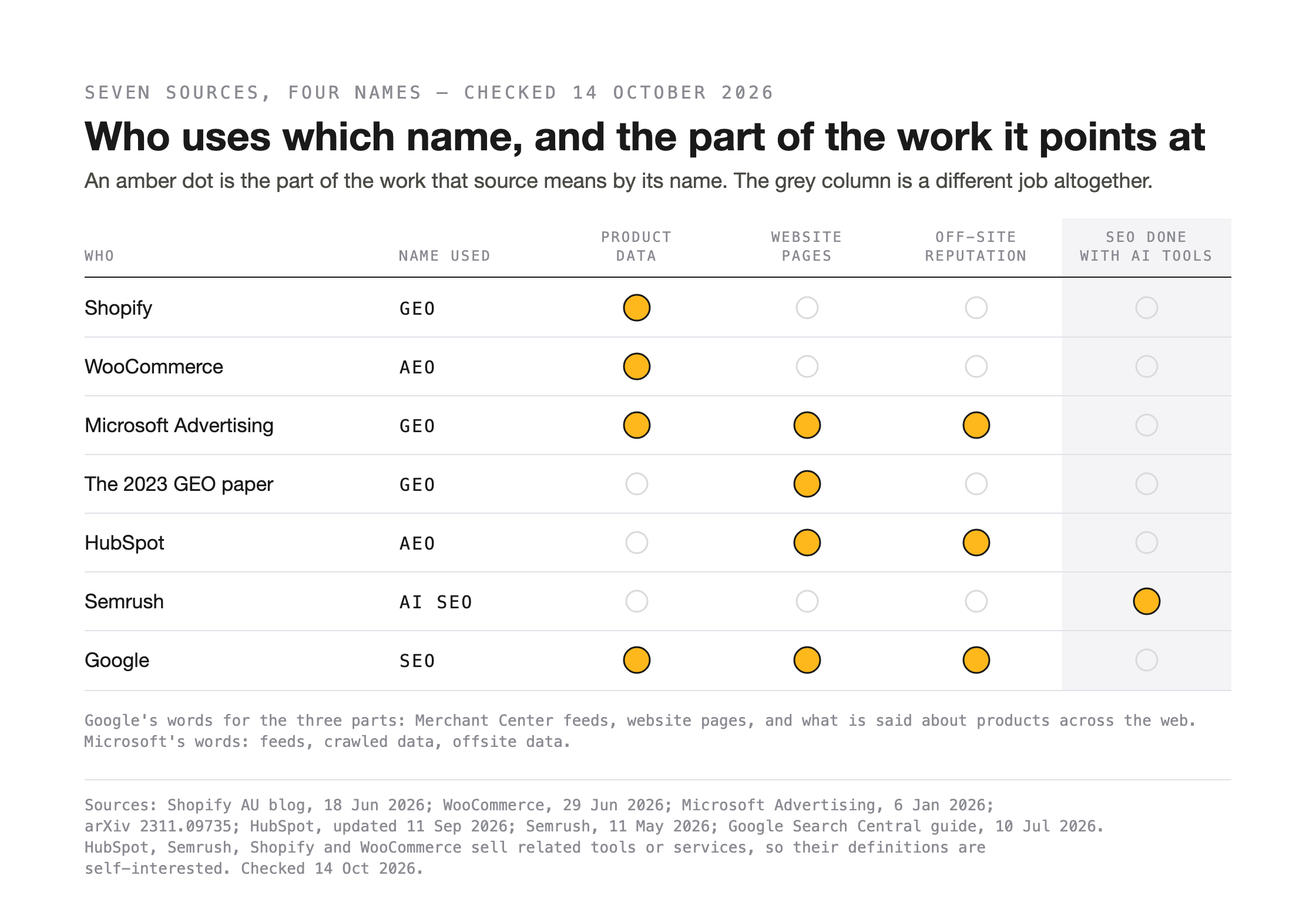
Each company or author below uses its name for a different part of that work.
| Who | Name they use | Part of the work it points at |
|---|---|---|
| Shopify | GEO | Product data |
| WooCommerce | AEO | Product data, including structured data and Merchant Center feeds |
| Microsoft | GEO | Feeds, crawled data and off-site data |
| The 2023 GEO paper | GEO | Website text |
| HubSpot | AEO | Citations and mentions, on the site and off it |
| Semrush | AI SEO | Using AI tools to do SEO |
| SEO | Website pages, Merchant Center feeds and what is said about products across the web |
If Google says no special optimisation is needed, is a quote for any of these names worth paying for at all? Google still says SEO best practice applies and that Merchant Center feeds help products show in AI responses, so the work is the ordinary work done thoroughly. Whatever name a quote uses, it is worth paying for when it names which part of that work your store might lack.
What Duelling Pixels calls it
Duelling Pixels calls this work AI Search. It is the same work others sell as GEO, AEO or AI SEO: finding out what AI assistants say about a business, then changing it. The work runs in four steps. First, record where the business appears in AI answers today. Then find what is holding it back, make the changes, and ask the same questions again to see what moved.
The first step is free. The AI Search report puts fifty buyer questions to five AI tools and shows which questions name the business, which name a competitor and which pages the assistants relied on. Answers vary between runs, so the report records one day, not a standing result. Duelling Pixels does not promise rankings, visits, sales or an AI recommendation.
Five questions to ask before you sign a quote
Start by writing down, in your own words, the result you want. An invented example is “our linen sheets named when someone asks Google AI Mode for linen sheets under $200”. With that sentence in hand, ask each provider five questions:
- Which name covers this result, and what work does it include?
- Which of the three parts does that work cover, product data, website pages or off-site reputation?
- What will be measured, and in which tool? Three reports give figures you can check yourself. Google Search Console’s generative AI performance report shows how your website’s pages perform in Google’s AI features. Merchant Center’s AI performance insights show how visible your products are in Google’s AI shopping results. Bing Webmaster Tools, Microsoft’s service for website owners, has an AI Performance report that counts how often your site is shown as a source in AI-generated answers.
- What will be changed on your store, in your feed or on other sites?
- What is not promised?
Google suggests one more question for anyone offering AEO or GEO services. Its guide to hiring an SEO tells you to ask whether their advice is aligned with Google Search’s official guidance on generative AI features. A quote that answers all six in plain words is ready for a price comparison. A quote built around buying ads sells something else, because OpenAI says ads in ChatGPT don’t influence its answers.
If you would like to see where your store appears before you write down your result and ask for quotes, request our free AI Search report. We typically respond within one business day.
References
- Aggarwal, Murahari, Rajpurohit, Kalyan, Narasimhan and Deshpande, GEO, Generative Engine Optimization, arXiv 2311.09735, first submitted 16 November 2023, abstract. https://arxiv.org/abs/2311.09735
- Semrush, AI SEO guide, 11 May 2026. https://www.semrush.com/blog/ai-seo/
- Aggarwal and others, GEO, Generative Engine Optimization, arXiv HTML version 3, 28 June 2024. https://arxiv.org/html/2311.09735v3
- Eric Enge and Adrian Ridner, Using Generative AI for SEO, O’Reilly, July 2025, chapter 8 (book, no link).
- Shopify Australia, Agentic Commerce on Shopify, How It Works, 18 June 2026. https://www.shopify.com/au/blog/how-agentic-commerce-works
- Perplexity Help Center, How does Perplexity work? https://www.perplexity.ai/help-center/en/articles/10352895-how-does-perplexity-work
- Jason Barnard, BrightonSEO 2018 write-up. https://jasonbarnard.com/digital-marketing/conferences/offline/brighton-seo/
- Kalicube, Answer Engine Optimization entity page. https://kalicube.com/entity/answer-engine-optimization/
- HubSpot, What is answer engine optimization (AEO), updated 11 September 2026. https://blog.hubspot.com/marketing/answer-engine-optimization
- Microsoft Bing Webmaster Blog, Introducing AI Performance in Bing Webmaster Tools Public Preview, 10 February 2026. https://blogs.bing.com/webmaster/February-2026/Introducing-AI-Performance-in-Bing-Webmaster-Tools-Public-Preview
- Mangools, AI SEO, What It Is, How It Works and How to Improve Visibility, 22 March 2026. https://mangools.com/blog/ai-seo/
- Nathan Gotch, AI SEO For Dummies, Wiley, 2026 (book, no link).
- Google Search Central, Optimizing your website for generative AI features on Google Search, updated 10 July 2026. https://developers.google.com/search/docs/fundamentals/ai-optimization-guide
- Google Search Central, AI features and your website, updated 10 December 2025. https://developers.google.com/search/docs/appearance/ai-features
- Microsoft Advertising, A Guide to GEO, 6 January 2026. https://about.ads.microsoft.com/en/blog/post/january-2026/from-discovery-to-influence-a-guide-to-aeo-and-geo
- Google Search Central, Google crawlers and fetchers overview. https://developers.google.com/search/docs/crawling-indexing/overview-google-crawlers
- OpenAI Help Center, ChatGPT search, Internet Archive capture of 23 September 2026. https://help.openai.com/en/articles/9237897-chatgpt-search
- Anthropic, Claude Help Center, Enabling and using web search. https://support.claude.com/en/articles/10684626-enabling-and-using-web-search
- Duelling Pixels, SEO vs AEO, A Small Business Guide for 2026, 9 June 2026. https://duellingpixels.com/blog/business-online/seo-vs-aeo-small-business-guide-2026/
- Google Merchant Center Help, Create a product file for Merchant Center. https://support.google.com/merchants/answer/12631822
- Google Search Central, Intro to how structured data markup works. https://developers.google.com/search/docs/appearance/structured-data/intro-structured-data
- Google Search Central, Product structured data. https://developers.google.com/search/docs/appearance/structured-data/product
- Google, The Keyword, shopping updates from Google Marketing Live, 20 May 2026. https://blog.google/products-and-platforms/products/shopping/shopping-updates-google-marketing-live/
- OpenAI Help Center, Shopping with ChatGPT Search, Internet Archive capture of 16 September 2026. https://help.openai.com/en/articles/11128490-shopping-with-chatgpt-search
- WooCommerce, How to make your store readable to AI shopping agents, 29 June 2026. https://woocommerce.com/posts/woocommerce-ai-shopping-agents/
- Google Merchant Center Help, About AI performance insights. https://support.google.com/merchants/answer/17200695
- Google, The Keyword, Boost your holiday sales with these agentic commerce updates, 16 September 2026. https://blog.google/products-and-platforms/products/shopping/google-shopping-updates-holiday-shopping/
- OpenAI developer docs, Products feed specification. https://developers.openai.com/commerce/specs/feed
- Google Search Console Help, Generative AI performance report (Search). https://support.google.com/webmasters/answer/16984139
- OpenAI developer docs, Overview of OpenAI Crawlers. https://developers.openai.com/api/docs/bots
- Duelling Pixels, AI Search Optimisation & GEO, fetched from the new site build 21 October 2026. https://duellingpixels.com/ai-search-optimisation/
- Google Search Central, Do you need an SEO expert?, updated 5 June 2026. https://developers.google.com/search/docs/fundamentals/do-i-need-seo
- OpenAI Help Center, Ads in ChatGPT, Internet Archive capture of 4 October 2026. https://help.openai.com/en/articles/20001047-ads-in-chatgpt

Leave a Reply