
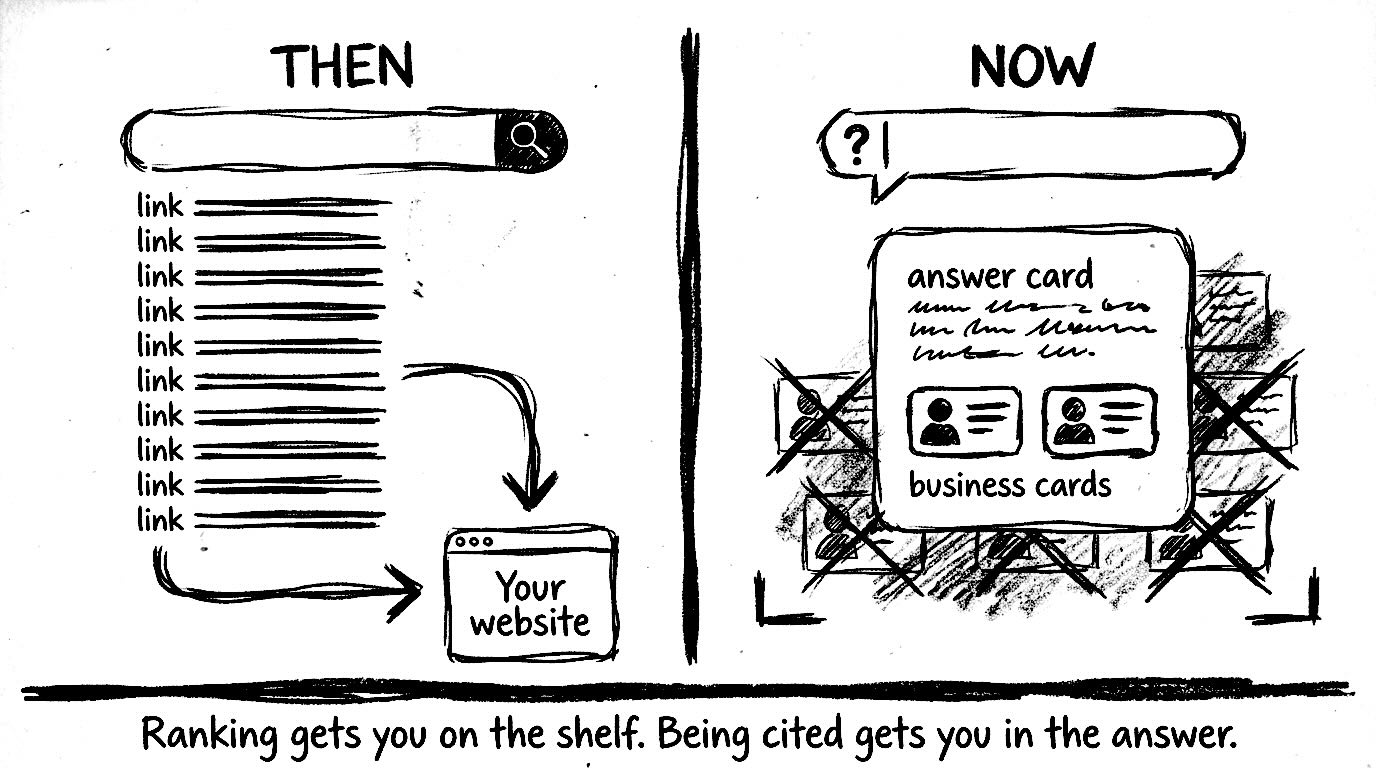
For twenty years the deal was simple. You optimised your site, you ranked on Google, and Google sent people to your door. That deal is breaking. People now ask an AI a question and get a finished answer, with two or three businesses named inside it and no need to click anything. If you are one of those names, you win. If you are not, you have effectively vanished from that search, no matter how well your page would once have ranked.
This is the shift from SEO to AEO, and for small business owners and business leaders, it is one of the most important changes in how you get found since the advent of the smartphone. The good news is that it is not a reason to panic or to tear up everything you have built. It is a reason to understand what has changed and adjust deliberately. Here is what SEO vs AEO actually means, how AI decides who it quotes, and what to do about it.
The traffic you used to win for leads is disappearing — fast
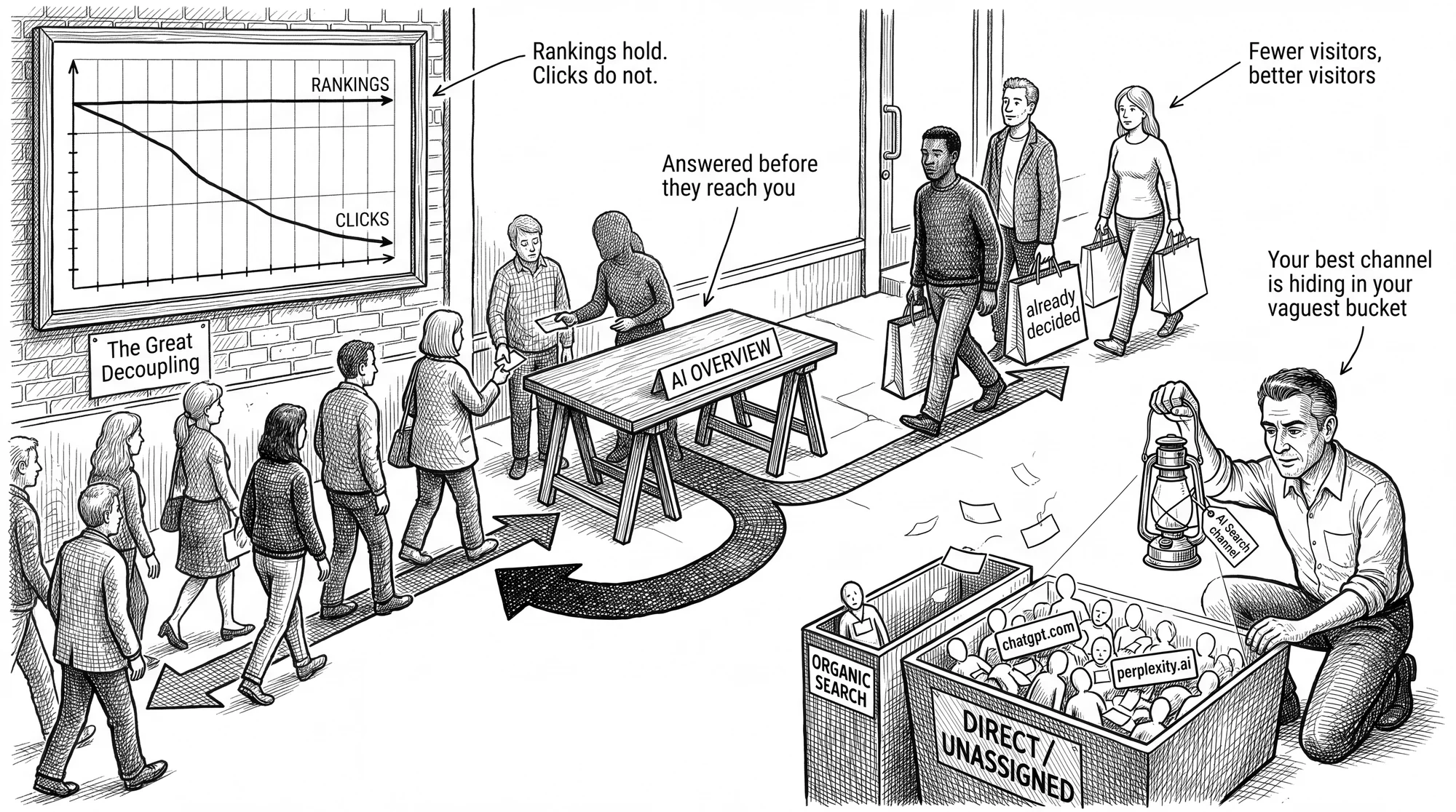
Let’s start with the uncomfortable numbers, because they explain everything that follows. When Google shows an AI Overview, the top-ranked organic result sees roughly a 58% lower click-through rate than it used to, as the search engine keeps the click within its own answer (Espress Labs, 2026). Ahrefs reported an average drop in clicks for affected queries of around 34.5% (Ahrefs, 2026).
Google is not hiding its intention to entirely move to an AI chat interface. This is the “zero-click” search era, and it is not a transitional phase. JPMorgan and Gartner both expect search-driven traffic to fall by around a quarter by the end of 2026 (SE Ranking, 2026).
The scale is already enormous and will continue to grow quickly. AI Mode passed a billion monthly users in 2026, and AI Overviews well over two billion (Google, 2026). For a sharp local read on why this is a strategic land grab rather than just “more AI”, our earlier piece on what Google I/O 2026 really means for your business is worth 10 minutes.
It can be drastic for many businesses that rely on content and SEO for marketing and lead generation. As an example, the independent product-testing site HouseFresh lost roughly 91% of its search traffic after a Google update, dropping from about 4,000 daily visitors to fewer than 200 as visibility shifted toward larger brands (HouseFresh, 2026). You probably won’t see a fall that steep on your website, but the signal and result is the same for everyone.
In simple terms, ranking is no longer the finish line. Being named inside the answer is.
SEO and AEO, in plain English
SEO — search engine optimisation — is the work of ranking your pages so a person clicks through to your site. AEO — answer engine optimisation — is the work of becoming the source an AI cites when it writes the answer instead of listing links. SEO chases the click. AEO chases the citation.
The most important thing to understand is that these are not semantics, and AEO is not a brand-new discipline you have to build and fund from scratch. Google’s own John Mueller put it bluntly: “Good AEO is good SEO.” The foundations are shared — quality content, a crawlable site, clear structure, real authority (SIAGB, 2026). Around 92% of AI Overview citations come from pages already ranking in the top 10, so strong SEO is the entry ticket, not wasted effort (Searchable, 2026).
But there is a real gap, and ignoring it is where businesses come unstuck. An analysis of nearly 40,000 queries found that 88% of citations in Google’s AI Mode did not appear in the top 10 organic results for that same query (GreenBananaSEO, 2026). The ranking pool and the citation pool overlap, but they are not the same pool. Good SEO gets you into the room. AEO is what gets you quoted and linked once you are there.
Be wary of anyone selling “AEO” as an expensive, separate product. A lot of it is ordinary SEO with a new label and a higher price tag.
How AI decides who it quotes and references
AI search engines build answers using Retrieval-Augmented Generation: they fetch live pages, judge them, then write a reply citing the sources they trust most. Four signals decide whether that source is you.
Does the machine know you exist? This is entity authority — a consistent, recognisable identity across the web. AI reinforces its confidence through “entity stacking”: seeing your business name appear alongside your industry on trusted third-party sites, directories and review platforms, not just your own pages (Sagefrog, 2026).
Can AI lift a clean answer from your page? Yes, this is citability. LLM models do not read like you or I; the models break a page’s content into chunks by heading and pull paragraphs as standalone units. Pages with clear structure and schema markup earn around 2.8x higher citation rates, and adding specific, sourced statistics can lift citation rates by up to 40% (Searchable, 2026).
Do other people vouch for you? This is source diversity, and it is where most small businesses are weakest. Roughly 90% of LLM citations point to earned media rather than your own website, and Reddit alone appears in over 40% of AI answers (Searchable, 2026). A brand only mentioned on its own site looks like self-promotion; a brand mentioned by trade press, forums and review sites looks like a trusted answer.
Is it recent? Freshness punches above its weight. Content under three months old is about three times more likely to be cited, and 76.4% of ChatGPT’s most-cited pages were updated within the previous 30 days (Searchable, 2026). In our experience, client websites that update content or product information weekly have much higher AI visibility than those that do not.
What this is worth: fewer clicks, better buyers
Here is the part that should change how you feel about the falling traffic. The visitors AI does send are worth far more. Across studies, traffic arriving from AI platforms converts at four to six times the rate of ordinary Google traffic — one widely cited case put ChatGPT referrals at 15.9% conversion against 1.76% for Google organic (Searchable, 2026). These are people the AI has already walked through their options; by the time they reach you, they are close to deciding.
Being cited also lifts the clicks you do get. Brands named in AI Overviews see around 35% more organic clicks, not fewer (Searchable, 2026). And the true value of the traffic upside compounds. After a structured AEO programme, the software firm incident.io lifted its tracked AI visibility from 38% to 64% in four months and reported a 22% increase in qualified meetings booked (Searchable, 2026).
Treat these figures as directional, not definitive. Most come from overseas studies and larger firms, and your mileage will vary by industry. But the pattern is simple, and we are seeing it in our clients’ data — fewer clicks, much higher value per click — that is consistent enough to plan around. In real terms, this means less traffic, but higher-value customers or clients.
A practical playbook for small businesses
You do not need an enterprise budget. You need to do a short list of things properly.
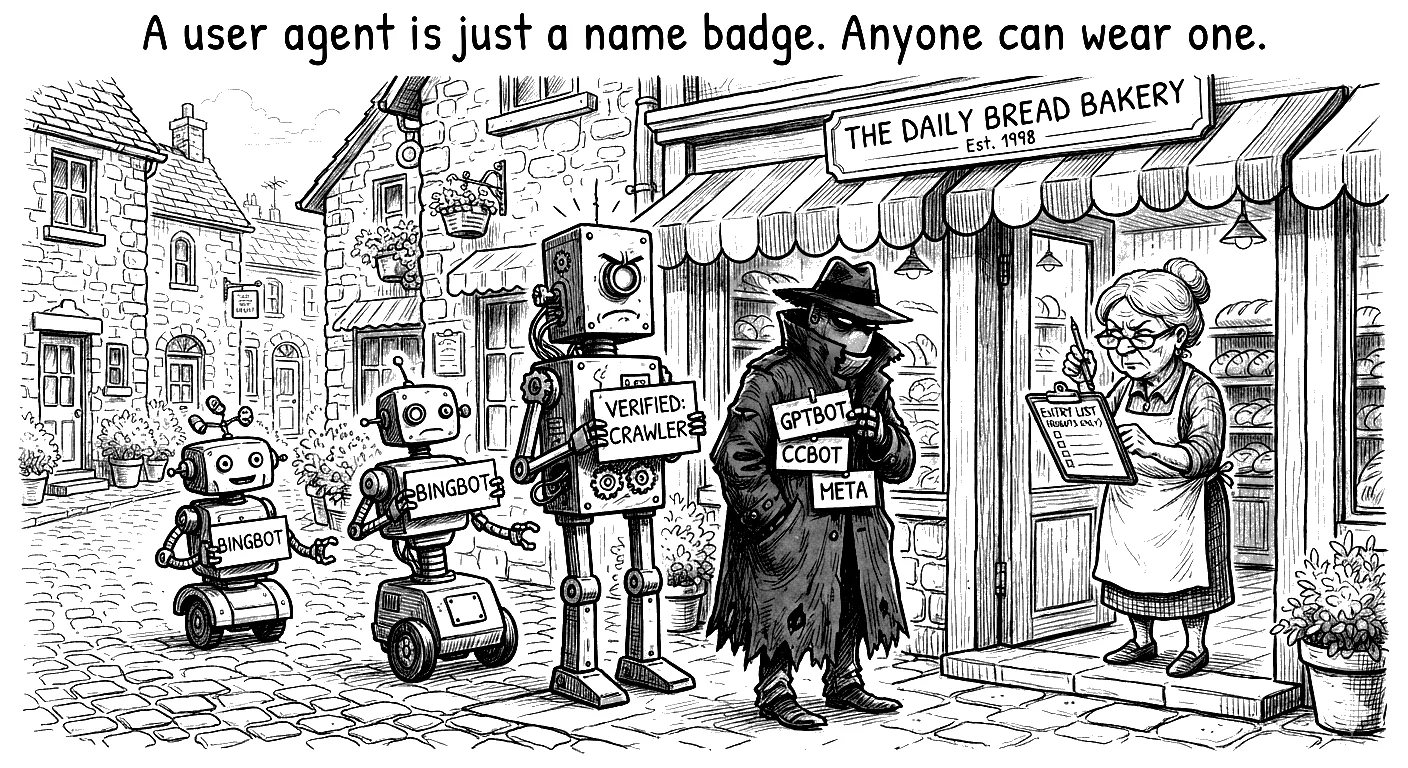
Check the AI front door is open. Look at your robots.txt and make sure you are not blocking the crawlers that feed AI answers — GPTBot, Google-Extended, PerplexityBot and ClaudeBot. Blocking them is opting out of the channel entirely (Searchable, 2026).
Write so a machine can quote you. Give every section a clear heading, then open it with a direct, 40–60 word answer to the question that heading implies. Use tables for figures and lists for steps. Sections should make sense if lifted out on their own.
Add structured data. Article, FAQ and Organisation schema in JSON-LD act as a machine-readable map of your content and business identity, and they remain valuable even though Google has trimmed the visual snippets it used to produce (Contentstack, 2026).
Say something only you can say. AI is built to flatten generic content, so volume for its own sake works against you. One article carrying original data, a real client outcome or a genuine point of view will out-earn fifty that restate the industry consensus, because originality is the one thing the model cannot synthesise from elsewhere.
Earn off-site mentions. Keep your details consistent across Australian directories and review sites, actively encourage genuine customer reviews, contribute real help in the communities your customers actually use, and pursue PR opportunities. This is the third-party validation layer that AI model companies use to turn your website content into citations.
Use Google’s new controls. Google is rolling out a Search Console AI Overview toggle that lets you decide whether your site appears in AI features and helps ground AI answers, plus new reports showing your impressions within AI features and which pages appear (Google, 2026). Watch for these landing on your account and use the data to see where you already show up.
Measuring success when the clicks dry up
If you keep judging your marketing purely by website traffic, you will conclude that you are failing when you are actually winning. This game is over, and the marketing metrics have to move with the channel change.
Track branded search lift and direct traffic. Typically, when someone reads an AI summary that recommends you, they often open a new tab and search your name, so growth in branded queries is a strong proxy for AI exposure (SE Ranking, 2026). In Google Analytics 4, filter referrals for domains containing ChatGPT, Gemini, Perplexity, Claude, or Copilot to isolate genuine AI sessions and investigate and track their conversion (Optimizely, 2026). Then, once a month, simply ask ChatGPT, Perplexity, and Google about your category and note whether you are named, whether the description is accurate, and how often you appear compared to competitors. That share-of-voice check is free and tells you exactly what to fix next.
Where to start this week
You cannot do all of this at once, so do not try. Start with three things that cost almost nothing. Type your business name into ChatGPT and Google’s AI answers and read what they say about you — if it is vague or wrong, that is your first job. Check that your robots.txt is not blocking AI crawlers from frontier model providers. And reformat your three most important pages with clear headings and a direct answer at the top of each.
SEO is not dead, and AEO is not a separate religion you have to convert to. It is the same instinct — be genuinely useful, be trustworthy, be easy to understand — applied to a search experience that now answers instead of lists. The businesses that come through this in good shape are the ones whose customers know their name, who own their customer relationships directly, and who read clearly to the systems now deciding who gets found.
If you would like a hand getting your business legible to AI search without the hype or the inflated “AEO” invoice, that is exactly the work we do.

Leave a Reply