
Watching Google I/O 2026 last week, it would have been easy to file the announcements under “more AI and more AI agents.” A faster Gemini model, a redesigned search box, a universal shopping cart, agents that book things for you. The presentation had an impressive new LLM model at the centre and a series of incremental changes to platform features and UI around it. The usual tech keynote.
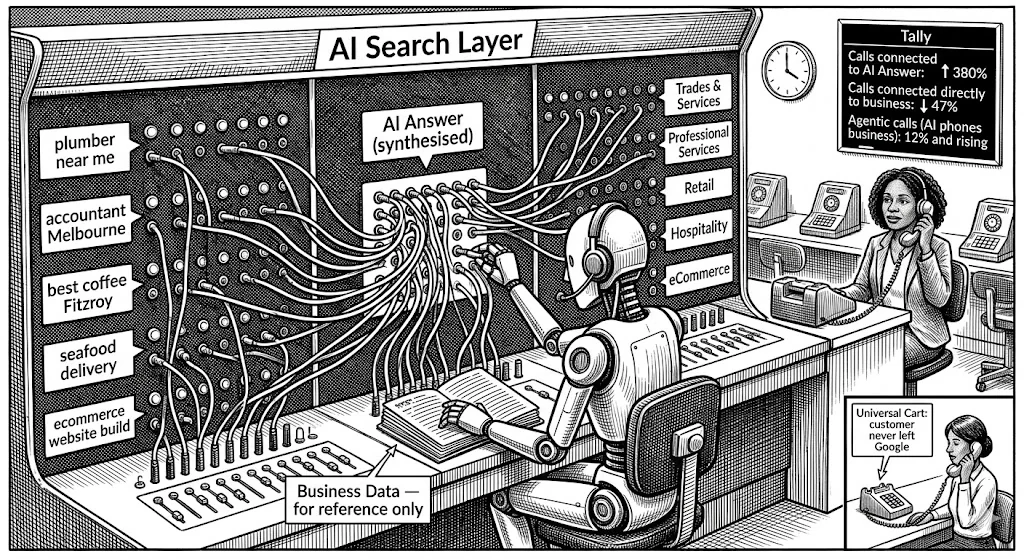
That reading misses what actually happened. Underneath the product demos was a single strategic move, and it’s a significant one: Google is replacing the open web with a layer it owns. The customer no longer travels from Google to your website to do business with you. They ask Google, and Google answers — using your business as a source, not sending anyone to your door.
For small businesses, this is the most significant change to how you get found since the smartphone. The awkward part is that it’s not coming. It’s mostly already happened.
What Google actually announced
Strip away the keynote theatrics, and Google I/O 2026 came down to a handful of announcements that matter for anyone who sells anything online.
The foundation for everything else was Gemini 3.5 Flash, which became the default model in AI Mode. The technical details are dull; the consequences aren’t. Flash gives Google frontier-level intelligence at a fraction of the running cost, which means Google can now afford to put AI on the front of every single search — billions of them a day — without the economics falling apart. Once the AI is free to run on every query, the AI becomes the default way search works. That’s the quiet decision that makes all the visible announcements possible.
The most visible change was the search box itself — Google’s biggest redesign of it in more than 25 years. It now expands as you type to handle longer, more conversational questions, and suggests ways to refine your query that go well beyond the old autocomplete. The search box has stopped being a place to type keywords and has become a place to have a conversation.
Then came the agents. Search agents now run in the background, monitoring the web and Google’s live data, and pushing notifications when something relevant turns up. You don’t search; you get told. Agentic booking goes further — Search can now gather pricing and availability for local services like home repair, beauty, and pet care, and in some categories it will phone the business on the customer’s behalf to check a price or book a slot. The customer briefs Google; Google calls you.
And for shopping, Google launched Universal Cart—an intelligent cart that works across Search, Gemini, YouTube, and Gmail, tracking items and prices and pulling the purchase together on Google’s own surfaces. One name was conspicuously absent from the launch partners: Amazon.
Each of these replaces something. AI Mode replaces the page of ten blue links. Search agents replace the customer’s habit of checking back. Agentic booking replaces the phone call the customer used to make to you. Universal Cart replaces your checkout page. The pattern is the point. The unit of search has shifted from a query to an outcome — and increasingly, Google delivers the outcome without the customer ever leaving Google.
What it actually means
Most of the coverage of I/O 2026 fell into one of two camps. Either breathless excitement that AI is transforming search, or technical checklists telling you which bit of website markup to update. Both miss the structural change, which is simpler and more consequential than either.
For twenty years, the deal was this: Google sent you to a website, and the website did business with the visitor. Google was the index; the web was the destination. The whole architecture of online marketing — SEO, content, landing pages, conversion funnels — was built on the assumption that the goal is to get the customer to your site.
That deal is ending. In the new arrangement, the customer arrives at Google and stays there. Your website is no longer the destination; it’s a data source that Google reads, summarises, and quotes inside its own answer. The customer gets what they needed without the trip. You become a supplier of information to Google’s interface, rather than a place the customer visits.
This changes what “being found” even means, in a few concrete ways.
Being cited matters more than ranking. When Google generates an AI answer, it names a few sources. Businesses cited inside those AI summaries earn meaningfully more clicks than competitors who aren’t named. That sounds like good news until you flip it around: if you’re not cited, you’ve effectively vanished from that search, no matter how well your page would have ranked under the old system. And most businesses won’t be cited, because an AI answer names two or three sources, not ten.
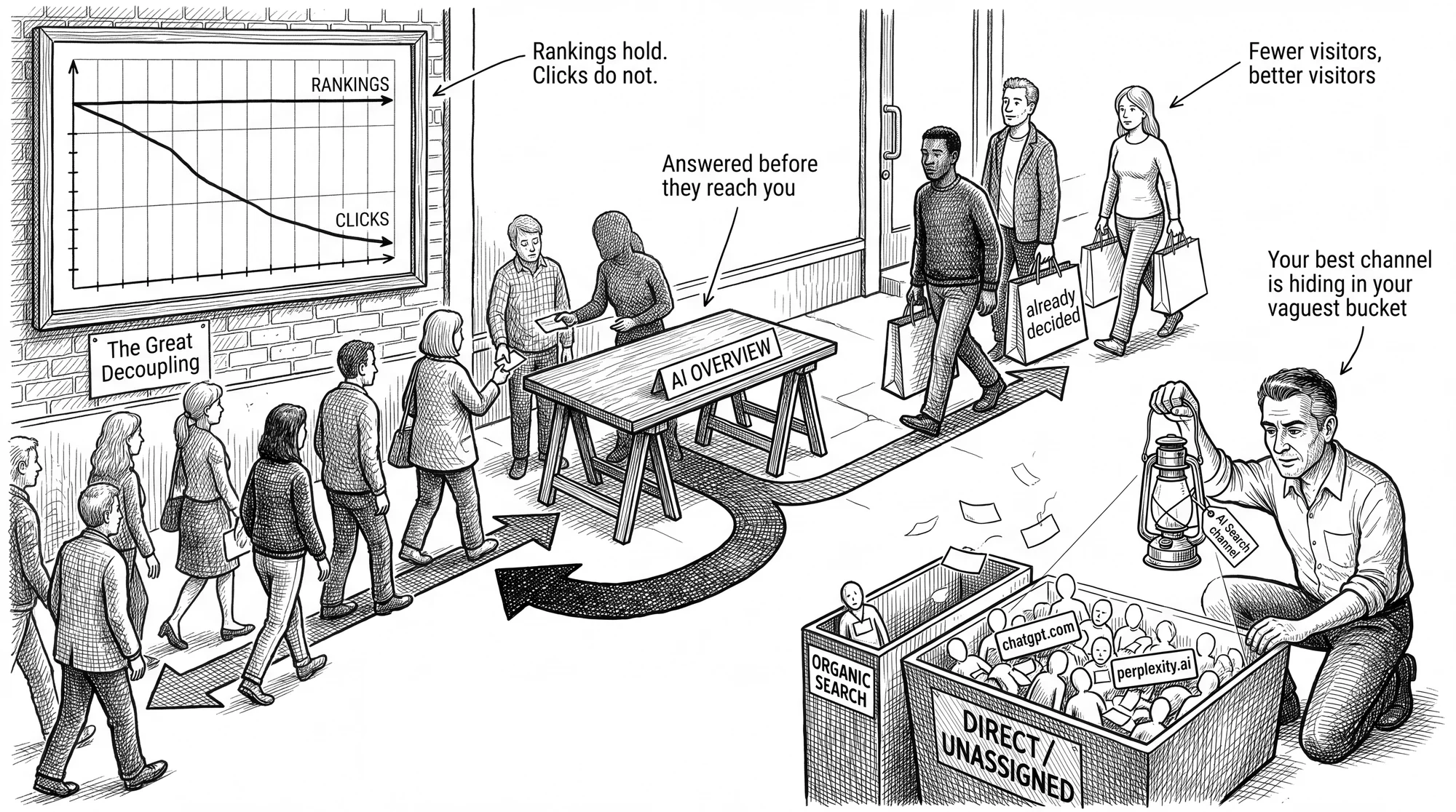
Click-through rate is quietly becoming the wrong thing to measure. AI Mode now has over a billion monthly users. A growing share of those users get their answer and never click anything at all. If your marketing is still being judged purely on traffic to your website, you’re measuring a number that’s structurally shrinking through no fault of your own.
Agentic booking is the genuine inflection point for local businesses. The moment Google can ring a business on a customer’s behalf, the customer’s mental model changes. They no longer think “I found a great local plumber called [your name].” They think “Google sorted it out.” You become an interchangeable fulfilment node behind Google’s interface, and the relationship — the thing that used to generate repeat business and referrals — belongs to Google, not to you.
Universal Cart leaving Amazon out is the tell. Google didn’t build a shopping cart to be a neutral helper. It built one to capture the moment of purchase on its own surfaces, on its own terms, without handing the customer or the data to a competitor. Every large platform is now doing a version of this — building walls around their slice of the customer journey because customer data is the fuel for their AI. The Australian small business owner is standing downstream of a fight between tech giants in which they have no seat and no stake.
Put plainly, the open web of 2005 to 2020 worked like a public square, where anyone could set up a stall and be found by anyone walking past. The web Google is building for 2026 and beyond works more like a set of private showrooms, with Google as the receptionist deciding who gets mentioned to the customer at the door.
For the first time, the central marketing question for a small business is no longer “how do we get found.” It’s “are we legible to the agent doing the finding.”
What this costs Australian small businesses
So far this is a global story. Here’s why it lands differently if you run a business in Australia.
The first reason is timing, and it works in your favour for now. Most of these features — agentic booking, search agents, the call businesses on your behalf capability — are rolling out to the United States first, through the back half of 2026. Australia, as usual, sits a few months to a year behind. That lag is not a reprieve; it’s a window. The businesses that use it to get their house in order will be ready when these features arrive. The ones who wait until their enquiries visibly drop will be reacting late, alongside everyone else.
The second reason is exposure. Australian small businesses are unusually dependent on local Google search. The “near me” query — plumber near me, accountant near me, seafood delivery near me — has been the engine of local Australian business discovery for over a decade. And the “near me” query is precisely what Google is moving into AI answers and agentic booking first. The part of search most Australian small businesses rely on the most is the part changing fastest.
It plays out differently across different kinds of businesses.
If you’re in trades or home services, agentic booking will increasingly route customers to whichever business Google can deal with most efficiently. A clean, accurate, complete Google Business Profile stops being good hygiene and starts being the thing that decides whether you exist in the customer’s options at all. Businesses with thin or out-of-date profiles get filtered out before a human ever lays eyes on them.
If you’re in professional services — law, accounting, consulting — you’re partially insulated, because these are high-consideration decisions that people don’t hand entirely to an agent. But the shortlist is increasingly compiled by AI. If you’re not in the three names the AI puts forward, you’re not in the running, and the prospect never knew you were an option.
If you sell products through ecommerce, Universal Cart and agentic shopping affect you directly, wherever Google can step between you and the buyer. The merchants who come through this in good shape are the ones who own the customer relationship outside Google — the repeat buyers, the email list, the people who’d come back to you by name.
And if you run a service business with a genuinely distinctive offering, you’re the most exposed to a subtler problem: flattening. When Google compresses your business into a two-sentence AI summary, all your careful positioning gets reduced to whatever the model decides you are. If the information it has about you is generic, you will sound generic — indistinguishable from every competitor in the same summary, regardless of how different you actually are.
Most owners reading this will recognise their business in at least one of those. That recognition is the point. This isn’t a far-off problem for big brands with marketing departments. It’s a near-term problem for exactly the kind of Australian small business that has always relied on being findable.
What everyone’s about to tell you to do — and what actually matters
Over the next six months, the Australian agency market is going to flood you with standard advice on how to survive this shift. Most of it will be defensive, and some of it is flat-out wrong. Here is what you are about to hear.
“Optimise for AI Overviews.” This is partly right, but mostly nonsense. Yes, citations matter, we are still optimising for this, but the underlying techniques are largely the same as those of good SEO. Anyone selling “AEO” as a brand-new service is just selling SEO under a new label and at a higher price.
“Build out massive content libraries.” This is the wrong direction entirely. AI Overviews are designed to flatten exactly this kind of content — generic, high-volume, written for an algorithm. Producing 200 articles that say what everyone else in your industry is already saying just helps the AI summarise the category. It does nothing to differentiate you, because there’s nothing in it that wasn’t already everywhere. The content that survives is the content that brings something genuinely new — a real insight, original data, a perspective drawn from actually doing the work, something your customers find useful enough to remember where it came from. One piece that says something true and new is worth more than fifty that restate the consensus. Volume was a search engine strategy that rewarded coverage.
The AI models reward originality because originality is the only thing they can’t synthesise from elsewhere.
“Spread your marketing budget across every channel.” This is defensive advice that protects the agency from being wrong, at the cost of being right. Most small businesses can’t afford to be present everywhere, and the businesses that try usually do everything badly. Instead of diluting your budget across five platforms just to tick boxes, use it to build your brand. The goal isn’t to be everywhere; it’s to build enough branded demand that the buyer searches for you by name, not by category.
“You need to be on TikTok / X / Threads.” This is channel proliferation acting as a substitute for actual strategy. The only channel that matters is the one your specific buyer uses to make a buying decision — not whatever happens to be trending in marketing newsletters this week.
Notice what all four have in common: they’re about doing more. More content, more channels, more spend. The counter-position starts from the opposite instinct.
Here is the position I actually hold. The businesses that survive AI-mediated search are not the ones that produced the most content or paid the most for ads. They are the ones whose buyers searched for them by name, or arrived via a trusted recommendation, or were the legitimate default in their specific niche.
If we accept that, then these three things genuinely matter right now, in this order:
- Branded demand. You need to be the name people type into the search box, not the category they describe.
- First-party relationships. You must own your email list, your customer history, and the direct line to the people who have already bought from you. Your customer data is your only true business moat in the AI world.
- Operational legibility. When an AI agent inevitably does need to summarise your business, you need to ensure it has clean, accurate, and structured information to work with.
Doing all three of those properly used to be expensive — expensive enough that a small business couldn’t afford the agency that did it well, and the agency couldn’t afford to do it well at a small business price. That maths is changing. AI-native operations are quietly making small-business marketing agencies economically viable again. The agencies still running on the old assumption — that you just produce more content, run more ads, and rank for more keywords — are about to find their pricing collapse against the ones that have rebuilt their economics.
What to actually do in the next 90 days
If you’ve read this far and recognised your business somewhere uncomfortable, here’s where to start. Not ten things. Three.
Audit your branded search. Type your business name into Google and look at what the AI says about you. If it’s generic, vague, or wrong, that’s your first fix. It costs nothing and takes twenty minutes, and it tells you exactly how legible — or invisible — you currently are to the system that’s about to mediate every customer you have.
Pick the one channel where your buyer actually decides — and build a brand there, not everywhere. Not the five channels you’ve been told to be on. The one. Then be honest about whether your presence there is sharp and memorable, or just present. The budget you’re tempted to spread thin across platforms does more work concentrated on becoming the name people remember.
Stop measuring content by volume. Start measuring it by whether it says something only you could say. Produce less, but make each piece carry a real insight from the work you actually do — the kind of thing a customer remembers and an AI can’t manufacture from the category average. One genuinely useful idea, published under your name, outlasts a year of articles that restate what everyone already knows.
The shift is real, and most of the advice catching up to it hasn’t yet. If your business showed up somewhere uncomfortable in this post, the branded-search audit above is the place to start — free, twenty minutes, no conversation required.
Duelling Pixels does this work for Australian small businesses: branded demand, owned customer relationships, and making sure you read clearly to the systems that now decide who gets found. We rebuilt how we operate so that doing it properly stacks up at small business prices — which, for most of the last decade, it didn’t. If that’s a conversation worth having, get in touch.

Leave a Reply