
AI hasn’t just added a new place to be found. It’s becoming the layer your customers decide through — and it gives them a sense of freedom while quietly taking the judgment.
For about twenty-five years, the thing standing between a customer and your business was a list. You typed something into Google, it returned ten links, and you decided which to trust. The list was cluttered with ads and gamed by whoever was best at SEO, but the choosing was still yours. You looked at the options and picked.
That layer is being replaced. Increasingly, your customer doesn’t get a list — they get an answer. They ask an AI what to buy, where to go, who to hire, and it hands back a verdict with the choosing already done. The shortlist, the comparison, the weighing of one option against another — all of it now happens inside a system the customer never sees, and the result comes back clean and singular, as though there were only ever one sensible answer.
This feels like freedom.
No more wading through ad-choked results and search-optimised filler to reach the thing you actually wanted. And it is a kind of freedom — from the noise. But look at what’s underneath it. The judgment didn’t pass to the customer. It passed to the machine. People feel more in control while handing over the most important part — the decision about what even gets considered — to an intermediary whose workings are invisible to them.
That is the shift worth understanding, and it’s bigger than “a new channel to optimise for.” AI is quietly becoming the most powerful intermediary in the history of consumer decision-making. Here is how it actually works and what it means for anyone trying to be found.
The machine is now the layer
The old filter was a search index that pointed at pages. The new filter reads the pages for you and reports back.
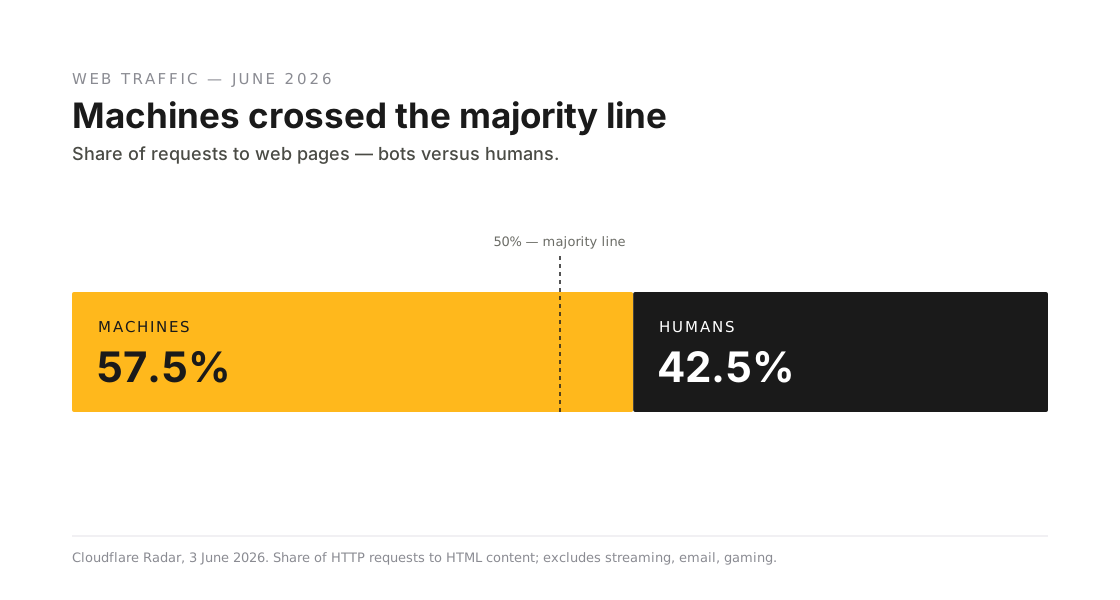
This isn’t a metaphor. Machines now move more of the web than people do — by mid-2026, Cloudflare measured automated traffic at over 57% of all web page requests, the first time bots have held the majority. The bulk of that is AI systems reading the web at enormous scale: crawling, ingesting, summarising, so that when a person asks a question, the model can answer from what it has already absorbed. The web is increasingly being read by software on behalf of people, not by the people themselves.
What comes back to the user is a single synthesised verdict. The model has done the looking, discarded most of what it found, and presented the residue as an answer. That act of discarding — deciding what’s worth surfacing and what isn’t — is the entire product. It’s also the part the user never sees. They asked a question and received a conclusion; the hundred things weighed and dropped along the way are gone before the answer is rendered.
That is what it means to call AI a decision layer. It isn’t helping people search. It’s doing the deciding and handing over the result.
It feels like freedom. That’s the clever part.
Here’s the tension at the centre of all this, and it’s worth holding rather than resolving, because resolving it loses the truth.
From the customer’s perspective, this is a better deal. The old results page was exhausting and faintly insulting — ten links, the top few paid for, the rest optimised to within an inch of their lives by whoever wanted your click most. Replacing that with a straight answer feels like being respected for once. Less noise, less manipulation, less work.
But the freedom is mostly felt rather than real. The customer hasn’t been handed more control over the decision. They’ve been relieved of the decision. The discretion that used to be theirs — which options to consider, which sources to trust, what to weigh — now rests with whoever built the filter. The person experiences autonomy. The intermediary holds it.
This is the pointy end of the whole change, and it cuts two ways. For the customer, it’s a quiet trade: the feeling of independence in exchange for the substance of it. For a business, it means the entity you now have to win over isn’t your customer at all. It’s the layer that decides what your customer ever gets to see.
The filter isn’t neutral
Once you see AI as the decision layer, the only question that matters is who it works for. The honest answer is: not the user, at least not only.
The economics settled this faster than most people noticed. For most of its life, ChatGPT ran on subscriptions; through 2026, that gave way to advertising, with ads appearing in the free tiers and a self-serve ad manager arriving soon after. The platforms also began charging at the checkout — OpenAI takes roughly 4% on purchases completed inside ChatGPT, while Google’s competing standard currently takes nothing, precisely to keep merchants close and protect the ad business it already has. The toll didn’t disappear when search became conversational. It moved.
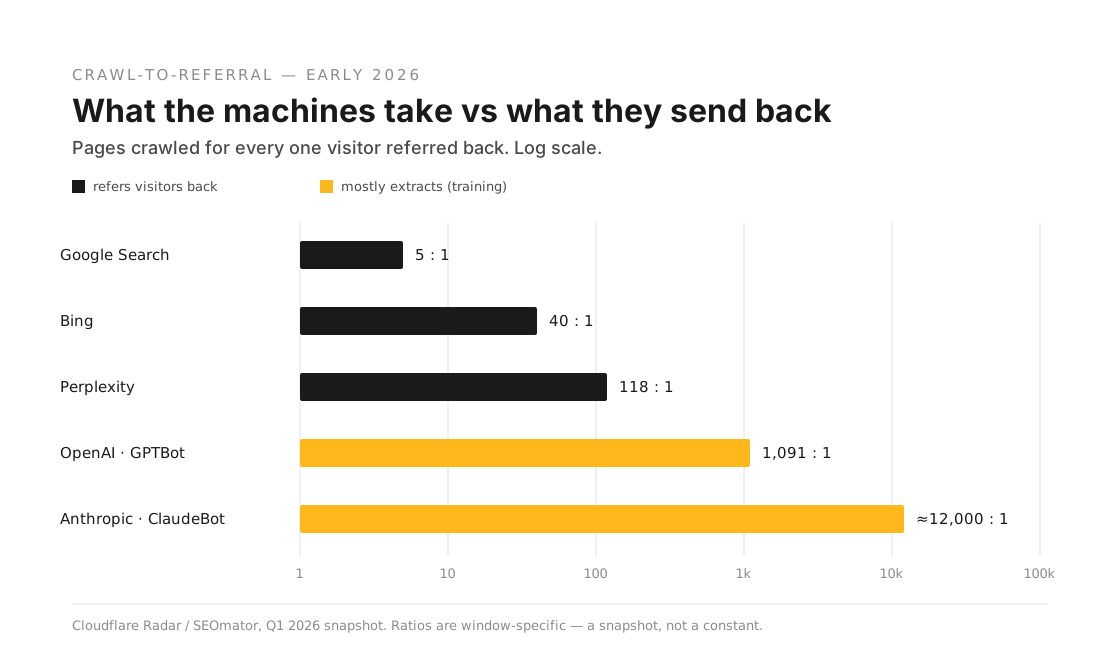
There’s a deeper extraction underneath the obvious one. The same crawlers that might one day cite you are mostly there to consume your content and send no one back. The ratio of pages taken to visitors returned is wildly lopsided — training crawlers read thousands of pages for every referral, against the handful-to-one ratio of traditional search. Your content goes on to power an answer that increasingly replaces the visit to your site. You are, in effect, helping build the filter that may decide to route around you.
And because the company that owns the filter often also sells the ad placement and stocks its own products, its claim to serve the user purely is structurally compromised. You can already see it: Amazon’s assistant folding sponsored results into conversational answers, and Google’s AI summaries keeping Google’s ad capture intact while starving the publishers they summarise of clicks.
One thing has not come back, though, and it’s worth being precise about it, because it’s the part your instinct about this was right on. You can buy a box of ad space beside the answer. You cannot buy your way into being the answer. At the moment the model reads your page to source its verdict, there is no auction. It is weighing whether your information is accurate, up to date, and trustworthy enough to use. That read can’t be bid for — it has to be earned. The paid mechanisms relocated; they didn’t reach all the way into the sourcing decision. That’s the one piece of leverage businesses still have, and it’s the piece worth building on.
People half-know this already
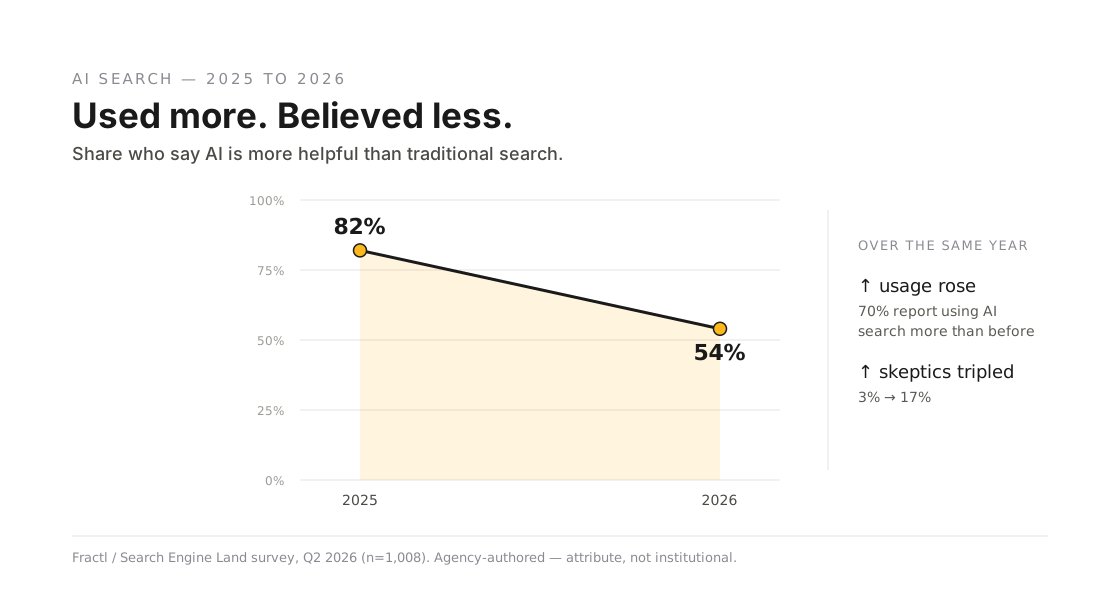
Here’s the evidence that the felt-freedom is starting to wear thin: people are using the filter more while trusting it less.
In one consumer study, the share of people who found AI more helpful than traditional search fell from over 80% to around 54% in a single year. They didn’t stop using it. They stopped believing it. The Australian picture sharpens the point in a way that surprises people. An Australian survey of 1,200 people in early 2026 found Millennials, not Gen Z, are the heaviest commercial users of AI — and Gen Z, the supposed natives, the most sceptical cohort of all, more likely to name AI their least-trusted source than their most. The same order turns up in US data, independent of the Australian survey: there, Boomers were more likely than Gen Z to find AI more helpful than search — the most-exposed generation, the least convinced. (Worth knowing both surveys were run by firms with a stake in the conclusion, so treat the exact numbers as indicative — but the direction holds across two independent samples.)
The explanation is simple and points straight back to the filter. Growing up inside algorithmic feeds didn’t make younger users trusting; it made them fluent in being marketed to. They sense, without necessarily articulating it, that a clean single answer is also an opaque one — that something is being decided for them and they can’t see the working. So they take the answer and go check it. The felt autonomy holds right up until the moment it’s tested, and then the scepticism kicks in.
That instinct is the opening for any business that’s actually any good.
If you’re the one being filtered
Put it all together, and the job changes shape. You’re no longer writing for a customer who lands on your page cold and makes up their mind there. You’re dealing with two gatekeepers in sequence, and they want opposite things.
The first is the filter. It decides whether you’re in the answer at all, and it doesn’t read brand stories or clever headlines — it reads structure. Accurate, current information; real availability; clear pricing; the practical facts a buyer needs, expressed as data a model can parse rather than prose it has to guess at. If those facts aren’t legible to the machine, you’re not in the shortlist it builds. You simply don’t appear. This is the entry fee.
But there’s a wrinkle here that most “be everywhere” advice misses. Not every machine reading you is doing you a favour. The crawlers split into two kinds: the ones retrieving content to answer a live question, which may send a real, pre-qualified customer your way, and the ones bulk-harvesting your catalogue to train a model that will answer in your place. Increasingly, the smart move isn’t to fling the doors open to all of them — it’s to welcome the crawlers that refer and get deliberate about the ones that only extract. Being readable is necessary. Being readable indiscriminately is a choice you should make on purpose, not by default. Almost no business has made it yet.
The second gatekeeper is the human, and they’re the one who actually decides — because, as the trust data shows, they don’t take the filter’s word for it. Handed a recommendation, they go and verify it. They look you up, read the reviews, and check whether real customers say what the AI said. This is where the sale is won, and it can’t be won with structured data. It’s won with genuine reviews in more than one place, real customer evidence, consistent third-party mentions — the things that survive a sceptic’s spot-check. Polished brand copy fails this test, and so, increasingly, does a flawless wall of five-star ratings, which now reads as manufactured rather than reassuring.
So there are two jobs, aimed at two different sceptics. Be legible enough for the filter to surface you. Be credible enough that the human believes you once it does. The optimisation gets you considered; the earned trust gets you chosen. Most businesses are deliberately doing neither.
A caution worth carrying, because it’s where this kind of thinking usually overreaches: being found by the filter and being rewarded by it are not yet the same thing, and the early data suggests they’re pulling apart. The machines that read you most relentlessly are, so far, the ones that send the fewest people back. It would be reasonable to expect the gap to widen before it closes — that the businesses surfaced in the answer won’t automatically be the businesses that get the visit. That’s a forecast, not a fact, but it’s the direction the numbers point, and it’s worth planning as if it’s true.
What’s actually changing
The old game was buying or earning a position on a list that people then chose from. The new game is being selected by a layer that does the choosing for them — a layer that may not be working in your favour, validated by a person who suspects as much and checks.
The bigger change lies beneath the marketing problem, and it’s the one to keep your eye on. The decision itself is moving. For the first time, the place where people work out what’s worth their money is not a page they read or a shop they walk into, but a synthesis delivered by a machine that doesn’t show its reasoning. That filter isn’t going away; it’s getting more total. The old one at least listed the options and let you choose among them. This one returns the already-made choice and feels like a gift as it does so.
That’s the trade worth naming, for your customers and for yourself. People are being handed the experience of more freedom and, in the same motion, quietly handing over the substance of it — to the most powerful intermediary the business of deciding has ever had. The businesses that come out ahead won’t be the ones that simply turned up in the answer. They’ll be the ones the filter found easy to read, and the doubtful human behind it found easy to believe. Being found was always the easy half. Being chosen — by a machine, and then by the person who doesn’t fully trust it — is the part worth the work.

Leave a Reply