
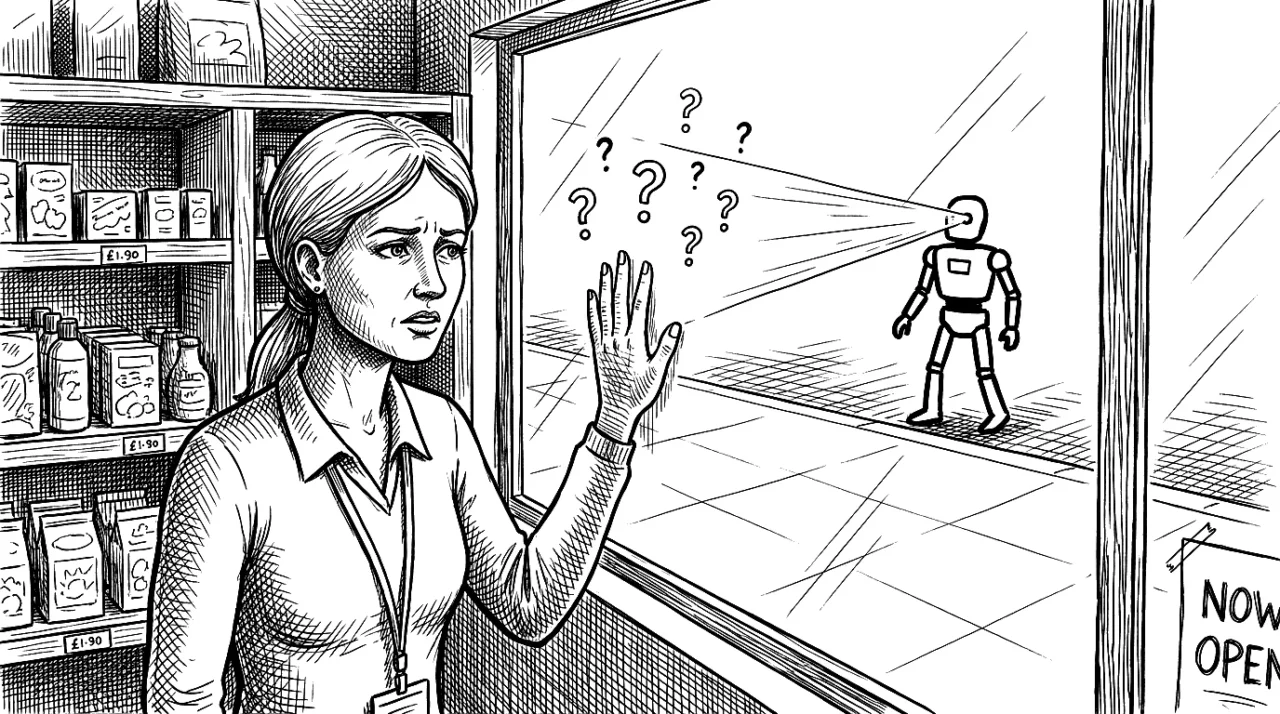
A shopper asks their AI assistant: “Find a dark roast coffee subscription under $40 a month with free shipping to Sydney.”
Your WooCommerce store has exactly the right product. The price is competitive. The stock is available. Your shipping rules match the request. Yet the AI recommends a competitor instead.
You lost the sale not because of SEO or website speed, but because the agent could not read your store. While your site may be visually strong for humans, it can be opaque to the software now used to help with purchasing decisions.
This is the reality of agentic shopping. It is not some distant idea waiting to arrive. The infrastructure is already taking shape. WooCommerce 10.3 recently introduced the Model Context Protocol (MCP) in beta, laying the groundwork for AI agents to interact with store data. WooCommerce, 2025.
Google describes this shift as “agentic commerce”, where AI tools move beyond simple search to compare products and help facilitate transactions on a user’s behalf Google, 2024.
For merchants, this creates a new challenge. Visibility is moving upstream. Ranking for keywords alone is no longer enough. Your store needs to be structured, accurate and legible enough for a machine to select it from the noise.
What agentic shopping actually is
Most store owners still work to a familiar model. You create content to rank well. A human clicks your link. Your website persuades them to buy. Agentic shopping changes that model entirely.
In this new setup, your “user” is software, not just a person. Google describes these tools as systems that work through a shopper’s needs, compare options and take action. In many cases, the human never even sees a search results page, Google, 2024.
Agents audit—checking your shipping, price, and stock in milliseconds. Visual elements like banners or copy do not matter. Only clean, accurate data counts.
This shifts the goal. You stop trying to rank and start trying to be selected. McKinsey describes this as a move from browsing-based commerce to delegation-based commerce McKinsey, 2024. You are no longer fighting for a click. You are competing to be the single best answer a machine can find.
If your product data is messy, the agent moves on. A human might forgive a confusing description or click around to work out shipping costs. An agent will not. If it cannot calculate the total cost with confidence, it excludes you.
To compete, your store needs to speak the language these agents understand. That requires a more deliberate setup, one that separates backend management from frontend purchasing.
Achieving this structural split means adopting the standardised languages and data that AI systems are actually programmed to speak. To make your store legible to both internal management agents and external buyer agents, you must understand the two frameworks governing this new era of commerce.
Model Context Protocol and Agentic Commerce Protocol explained
Two protocols drive this new realm of agentic shopping: the Model Context Protocol (MCP), developed by Anthropic, and the Agentic Commerce Protocol (ACP), developed by OpenAI and Stripe. MCP manages store operations by enabling backend data communication, while ACP facilitates AI-driven customer purchases at the frontend. MCP is like the staff entrance, handling internal processes, and ACP is like the front door, managing customer-facing transactions.
Model Context Protocol (MCP)
MCP acts as your backend manager. It connects AI models to your store’s internal data.
WooCommerce 10.3 now includes MCP in its core. This gives AI agents a standard way to read and write store data, reducing the need for custom code.
With MCP, you could tell an agent to “drop the price of all winter stock by 10% and email customers who bought a coat last year”. The protocol provides the model with the context it needs to perform the task more safely. It turns your WooCommerce dashboard into a more conversational interface for your team.
Agentic Commerce Protocol (ACP)
ACP acts as the frontend shopper. This standard allows a customer’s AI agent to browse your catalogue and complete a purchase.
It focuses on the transaction layer. Stripe explains how ACP enables “programmatic commerce flows” in which buyers hand purchasing authority to an agent (Stripe, 2025).
A key idea is the “Shared Payment Token.” Usually, the buyer enters card details at checkout. With ACP, the buyer generates a limited-use token for their AI to complete the purchase. This removes manual forms and streamlines the buying process.
The difference matters for your strategy.
You can think of the split like this:
- MCP (Model Context Protocol) improves store operations by enabling your staff and systems to efficiently manage and interact with backend store data.
- ACP (Agentic Commerce Protocol) enhances revenue by enabling external AI agents to access and process your store data for customer purchases, with a focus on frontend transactions.
Starpoint LLP notes that while MCP connects data sources, ACP addresses the trust and liability required for automated transactions (Starpoint LLP, 2025).
Installing one does not automatically give you the other. Many stores may use MCP to help manage inventory and operations, yet still remain invisible to ACP-based buyer agents if their frontend data is poorly structured.
Why most WooCommerce stores are currently invisible
You might be running the latest version of WooCommerce on a fast host, yet your products still remain invisible to agentic shoppers. The reason is simple. Most stores are built for human eyes rather than machine logic.
To a human, your product page is a shop window. To an AI agent, it’s a database row. If needed data is missing, your store may as well not exist. Agents read the raw HTML and structured data, not the visuals.
If your site uses generic tags or omits schema attributes, agents may not verify price or stock, so they may skip your product.
The missing data layer
Most WooCommerce sites suffer from “thin” product data. While the basic fields such as title, price and image are usually present, the more specific attributes agents rely on for filtering are often missing.
Google is very clear about this. Its Merchant Centre specifications state that incorrect or missing product identifiers, such as GTINs, MPNs, or brand names, can prevent products from appearing in Google Merchant Centre altogether (2025). If an agent is looking for a “blue cotton shirt under $50” and your product feed does not include explicit material and colour attributes, you may be excluded from the selection set immediately.
Agents rely on metadata rather than keywords.
Traditional SEO taught merchants to weave keywords into descriptions. Agentic shopping relies far more heavily on structured metadata. OpenAI’s recent shopping updates clearly show this shift. Their system pulls pricing, availability, and review data directly from structured sources rather than inferring them from paragraph text (Reuters, 2025).
When stores lack structure, agents perceive high risk. If they can’t verify the price or policy, they send the shopper elsewhere, favouring marketplaces with better data consistency.
The JSON-LD requirement
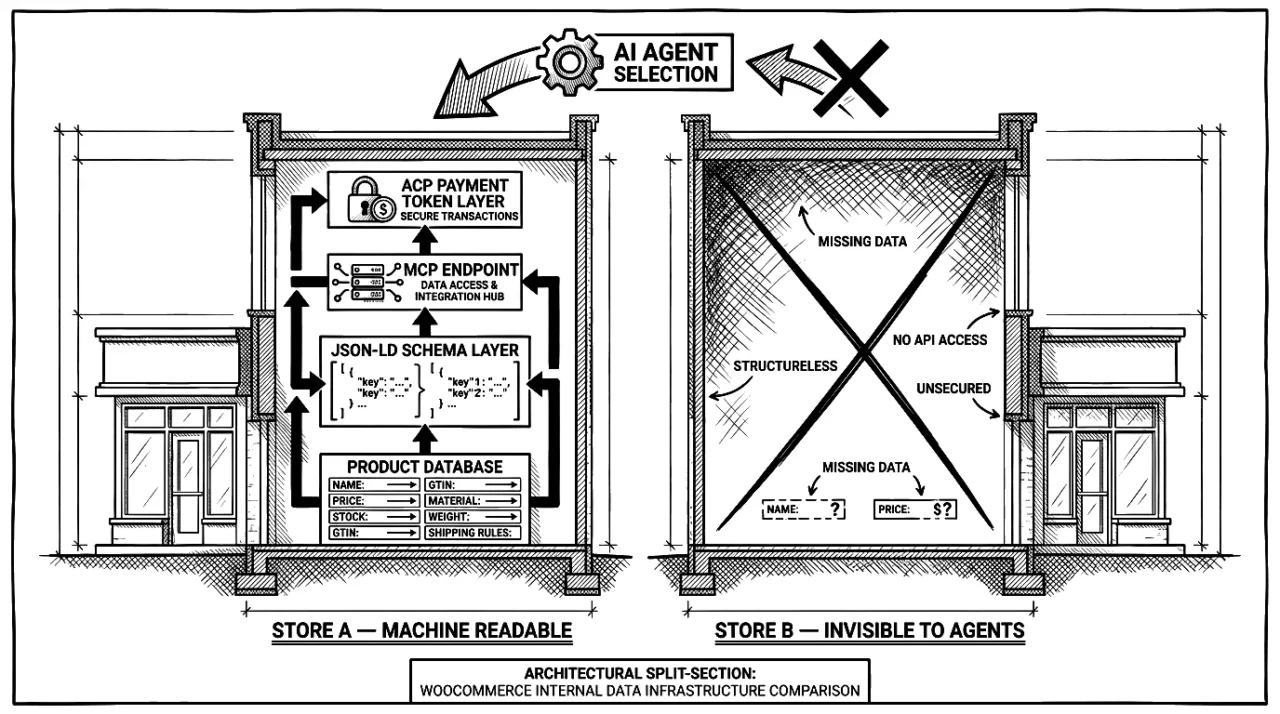
JSON-LD scripts in your site header provide agents with clear, machine-readable product data.
Without detailed JSON-LD, an agent has to guess. LightSite AI notes that agents prioritise sites where the data is explicitly defined in code, because it lowers the computational cost of “reading” the store LightSite AI, 2025.
Fixing this visibility gap is the first step. But opening your store to automated agents also introduces new operational challenges.
Liability, security, and attribution
Agentic shopping opens the door to new sales, but it also opens the door to new types of mistakes. Once you allow software to make decisions on behalf of a person, you inherit some of the risk when that software gets it wrong. Most merchants have not yet planned for that.
Security and “tool poisoning”
The technical risk starts with the Model Context Protocol (MCP), which lets AI tools access your store data via API-level permissions.
Security researchers describe one of the main threats as “tool poisoning”. This happens when an attacker feeds bad instructions or malicious data to an agent, tricking it into taking actions it should not take Pillar Security, 2025. Without strict human oversight, a compromised agent could theoretically change pricing, leak customer data, or manipulate inventory.
The liability of hallucination
Liability gets messy quickly. If a shopping agent hallucinates a 90% discount code or misreads a bulk pricing tier, you can end up in dispute before the product has even left the warehouse.
Visa warns that fraud is evolving alongside these tools. Bad actors are already using AI agents to test stolen cards or to uncover weaknesses in checkout logic (Ribdo/Visa, 2025).
For WooCommerce merchants, the core question is simple: who carries the cost of the mistake? Current terms from major AI providers are often still vague around financial liability and transactional errors. Signifyd notes that distinguishing between a clumsy agent and a malicious bot will become a major challenge for payment processors Signifyd, 2025.
Attribution blindness
Agentic shopping also disrupts how we track marketing performance. An AI agent does not click a Facebook ad or read a blog post in the same way Google Analytics 4 expects.
Sales influenced by agents may show up as “Direct” traffic. Worse still, some of that behaviour may be filtered out as bot traffic altogether. That creates a serious blind spot. You might see human traffic falling and bot traffic rising, and make the wrong call on your marketing spend as a result.
These risks do not mean you should sit this out. They mean you need to properly prepare your setup.
Practical next steps for WooCommerce merchants
You can prepare your store for agentic buyers without exposing the business to unnecessary risk. The goal is straightforward: make your product data easy for machines to read while keeping your backend secure.
Start with these three actions:
- Audit your structured data. Agents do not look at product photography or read your sales copy the way humans do. They read code. Run your product pages through a rich results test and ensure price, availability, and shipping attributes are explicitly defined in JSON-LD, not just visible in the HTML. Search Engine Journal notes that deep integration depends on a clean, error-free schema Search Engine Journal, 2025.
- Test MCP in a sandbox environment. WooCommerce 10.3 includes MCP features, but you should not switch them on blindly in a live environment. The developer documentation recommends testing agent interactions on a staging site first so you can verify exactly what data is exposed before real transactions are involved with WooCommerce, 2025.
- Tighten fraud review settings. Agents can execute transactions far faster than a human can click. Review your payment gateway settings so that high-velocity orders or IP addresses that match are flagged automatically. If an agent tries to purchase your full stock allocation in three seconds flat, your system needs to hit pause.
Next steps:
- Schedule a schema audit for your top 20 products.
- Update to WooCommerce 10.3 on your staging site only.
- Confirm your robots.txt allows agentic crawlers, including OpenAI’s bot, to access your product feeds.
Does your current development team have a plan to audit your schema this quarter?
The shift to machine customers
Agentic shopping changes the unit of competition. We are moving from ranking in a list to being selected by a program. Your WooCommerce store is no longer just a visual destination for human shoppers. It is increasingly an API-like resource for the software agents acting on their behalf.
The stores that win in this phase will not necessarily be the ones with the slickest design. They will be the ones with the most accurate, complete and structured data. If an agent cannot instantly read your inventory or pricing, it will likely move on.
Next steps:
- Treat your product feed as critical infrastructure.
- Audit your structured data for completeness.
- Monitor your traffic for agent-based patterns.
Would you like us to review your current schema setup?
Preparing for the agentic shift
The move from search rankings to agentic selection changes how we think about online retail. We are no longer optimising only for human eyes. We are structuring data for software that acts on behalf of the buyer.
The protocols discussed here, MCP and ACP, provide the framework for that interaction. They allow AI to read inventory, assess products and potentially process transactions without manual input. But none of it works well unless the underlying data is trustworthy. If an agent cannot verify stock levels, pricing or shipping costs instantly, it will move to a competitor. We already see this gap across many WooCommerce stores.
Security also remains a priority. You need to protect your store from bad actors while still allowing legitimate agents to operate. That means stronger fraud controls, tighter permissions and clearer terms around AI-driven interactions.
This technology is already in motion. The merchants who prepare now will be in a far stronger position than those who wait until machine-led buying becomes impossible to ignore.

Leave a Reply