
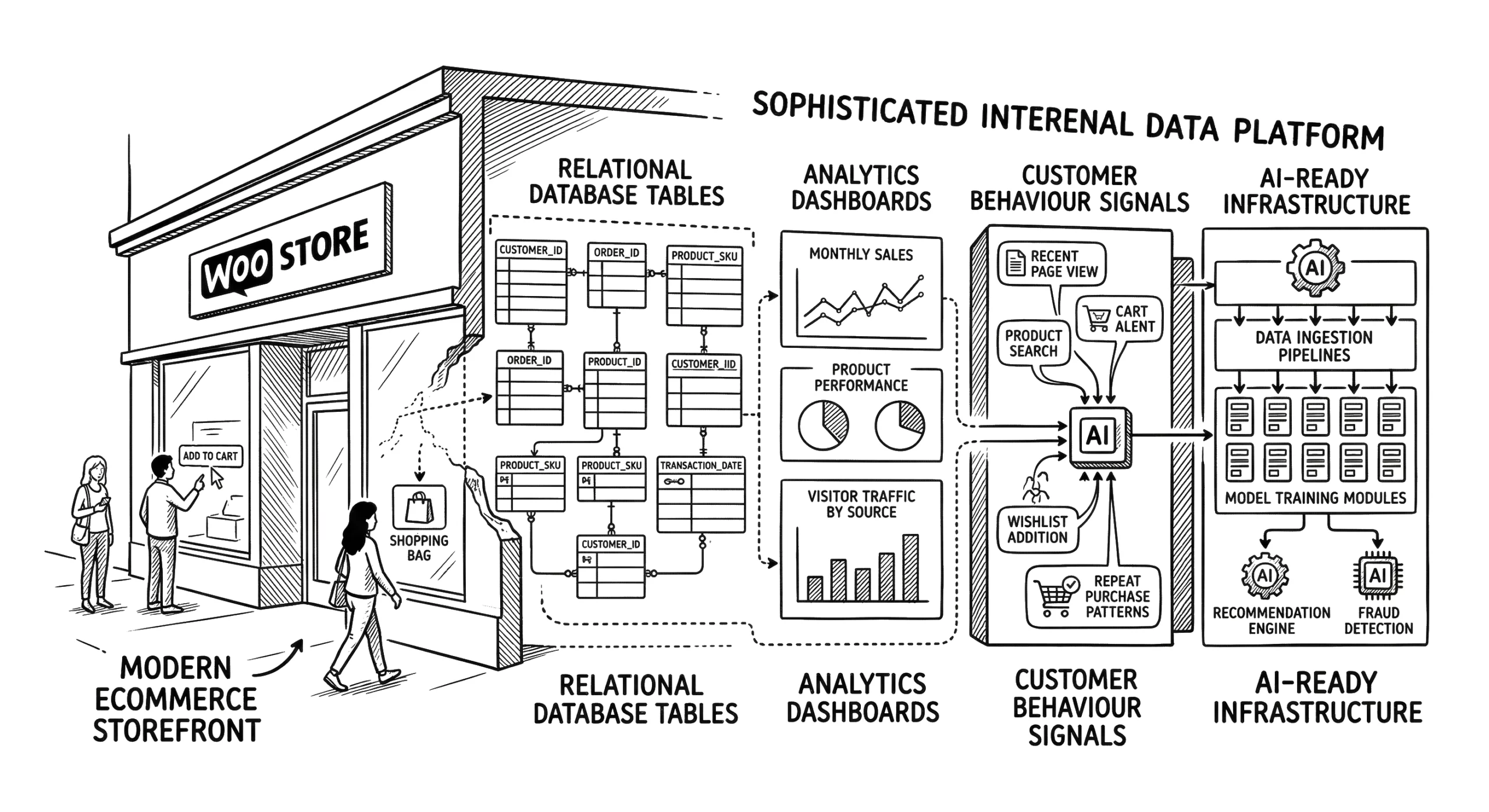
Most e-commerce founders treat their WooCommerce site as a digital vending machine. You stock the shelves, process the transaction, and focus entirely on the front-end display. This passive approach overlooks the fact that your store is actually a high-fidelity data warehouse disguised as a shopfront.
The distinction matters because the technical and legal landscape is shifting. Recent updates like High-Performance Order Storage (HPOS) have moved order data into dedicated tables, allowing for up to 40x faster filtering and significantly better reporting capabilities AppScenic, 2025. This change transforms your database from a messy post-meta ledger into a structured asset ready for advanced analytics. Unlike rented SaaS platforms that often silo customer insights behind API limits, WooCommerce offers direct access to the raw truth of your business.
However, owning this data brings new responsibilities. With the Australian Privacy Act reforms set to impact small businesses in 2025, the “collect everything, delete nothing” method is becoming a legal liability LegalVision, 2025.
If you continue to view your site merely as a place to sell goods, you limit your valuation and increase your risk profile. We suggest viewing your WooCommerce installation as a proprietary data platform—one that drives growth through intelligence rather than just volume.
The Shopfront Fallacy Limits Your Valuation
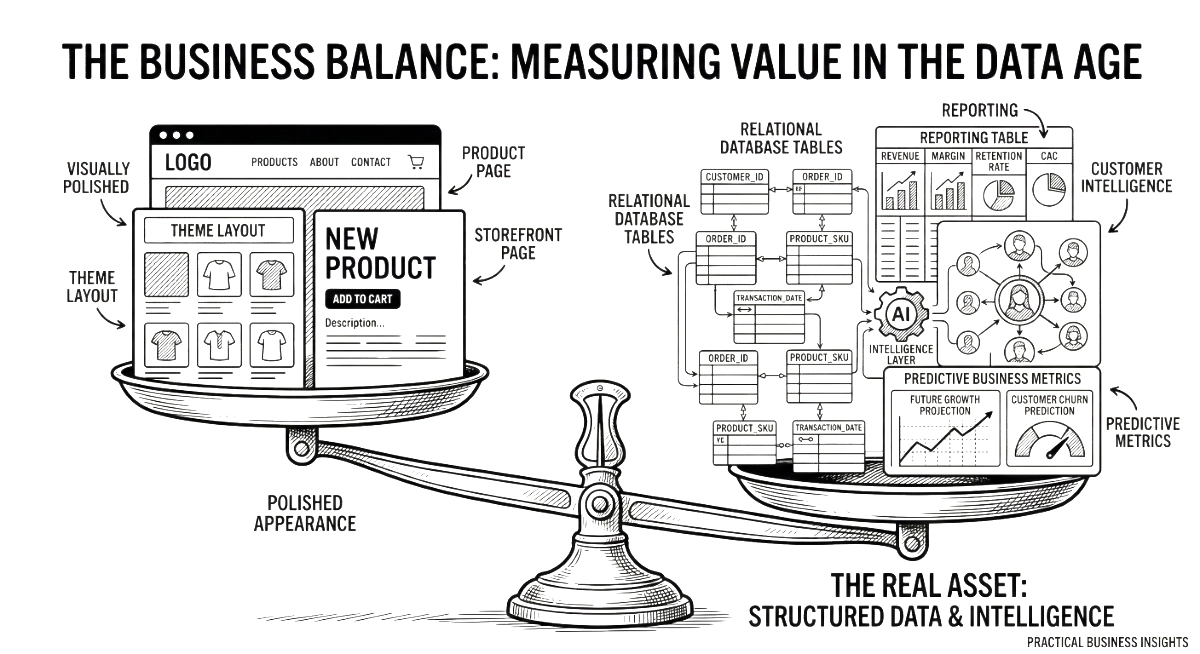
Focusing solely on the visual “shopfront” creates a low ceiling for your business value. Most merchants obsess over pixel-perfect themes or the colour of a checkout button. While these elements impact conversion rates, they do not build long-term equity. The real asset sits in the database tables that record customer intent, purchase frequency, and product velocity.
Major players understand this distinction well. They do not view their websites as mere catalogues. For instance, Coles leverages an AI-driven platform to process over 1 billion daily predictions, allowing them to tailor stock levels and offers with extreme precision Microsoft, 2024. They treat every digital interaction as a data point to refine their operational model.
This specific advantage creates a defensive moat around their business. The ACCC’s recent inquiry into supermarket dominance highlights how these sophisticated data ecosystems entrench market power and make it difficult for smaller operators to compete Bartier Perry, 2024. Independent merchants cannot match that volume, but they can replicate the logic.
We suggest shifting your mindset from “selling products” to “building a proprietary dataset.” When you eventually exit or seek investment, buyers will scrutinise your data quality. A store with a rich, organised history of customer behaviour commands a higher multiple than a store with messy records.
A “shopfront” business is worth the cash it generates today. A “data platform” business is worth the future revenue it can predict. However, capturing this value requires the right technical foundation. The default WordPress database structure was not originally built for this level of commerce intelligence, which is why recent structural changes to WooCommerce are so critical.
High Performance Order Storage Changes the Data Structure
For over a decade, WooCommerce relied on a database structure that was never designed for high-volume commerce. It stored every order as a “post,” effectively treating a $500 transaction the same way WordPress treats a blog entry. The core record lived in the wp_posts table, while critical business details—billing addresses, product SKUs, and payment statuses—were scattered across the wp_postmeta table.
This architecture creates a significant bottleneck for any store processing more than a few dozen orders a day. In technical terms, this is an Entity-Attribute-Value (EAV) model. While it offers great flexibility for plugins, it is inefficient for retrieval. To generate a simple sales report, the database must scan millions of rows of unindexed text and “join” them together. This is why your dashboard slows down during sales events.
High-Performance Order Storage (HPOS), formerly known as Custom Order Tables, fixes this fundamental flaw. It moves order data out of the generic post tables and into dedicated, commerce-specific tables like wp_wc_orders and wp_wc_order_addresses. This change normalises the data structure. It places order information into a relational format where each piece of data has its own column, rather than being dumped into a generic metadata bucket Pressidium, 2025.
The immediate impact is speed. Because the database no longer needs to parse the postmeta table for every query, order creation speed improves by up to 5x. More importantly for your operations teams, filtering orders in the backend—such as searching for all customers who bought a specific SKU in December—becomes up to 40x faster AppScenic, 2025.
However, the speed increase is just the surface benefit. The strategic value lies in data accessibility.
When your data lives in wp_postmeta, it is difficult to extract for external analysis. Business Intelligence (BI) tools like Tableau, Microsoft Power BI, or Google Looker Studio struggle to read the “spaghetti” structure of WordPress metadata. They require clean, relational tables to function correctly.
By switching to HPOS, you align your store’s database schema with standard data engineering practices. This allows you to:
- Run complex SQL queries directly against your order history without crashing the site.
- Sync data to external warehouses with lower latency.
- Build accurate customer lifetime value (CLV) models without missing data points hidden in meta fields.
We suggest enabling HPOS not just for the performance gain, but to prepare your infrastructure for external reporting. It transforms your store from a slow content management system into a structured transaction engine WooCommerce, 2023.
Once you have this structured data, you gain clarity. However, holding this level of granular customer detail in a readable format brings us to a critical intersection of technology and law. As your data becomes more accessible, it also becomes a greater liability under new regulations.
New Privacy Laws Turn Passive Data Into Liability
Structuring your data with HPOS makes it easier to query, but it also makes it easier to audit. This visibility is arriving just as the regulatory environment for Australian businesses shifts dramatically. For years, small to medium enterprises operated under a “safe harbour” regarding customer data, but that era is effectively over.
The most significant change concerns the small business exemption in the Privacy Act 1988. Historically, businesses with an annual turnover of less than $3 million were exempt from strict privacy compliance obligations. However, the government’s response to the Privacy Act Review Report confirms that this exemption is being removed to align with modern digital risks Schiller Legal, 2024.
This means a standard WooCommerce store turning over $500,000 is likely to face the same data governance requirements as a bank or an insurer.
Most e-commerce merchants default to a “collect everything, delete nothing” strategy. You might have ten years of customer addresses, phone numbers, and purchase histories sitting in your database “just in case.” Under the new Privacy and Other Legislation Amendment Bill 2024, this passive hoarding transforms from a bad habit into a quantifiable legal risk InfoTrust, 2024.
If you hold data you no longer need for a specific business purpose, you are required to destroy or de-identify it. WooCommerce does not do this out of the box. By default, it retains order data indefinitely.
We suggest reviewing your data retention settings immediately. You can configure WooCommerce to anonymise inactive accounts after a set period, such as 36 or 48 months. This reduces your attack surface. If a breach occurs, you cannot lose data you no longer hold.
The shift is not just about avoiding fines. It is about operational hygiene. A database clogged with obsolete customer records slows down queries and skews your analytics. When you remove the noise of customers who haven’t bought since 2018, your reporting becomes sharper.
This is where the difference between a “rented” platform and an “owned” platform becomes critical. On a SaaS platform, you are often limited to the data tools they provide. On WooCommerce, you have direct access to the SQL database, giving you the power to run custom anonymisation scripts or export data for compliance audits without hitting API limits.
Owning the database gives you the control to comply with these new laws on your own terms. However, it also highlights a major functional difference between WooCommerce and its SaaS competitors: the ability to access raw data without asking for permission.
SaaS API Limits Versus Direct SQL Access
The difference between “rented” and “owned” commerce becomes sharpest when you try to extract your data in bulk. On a SaaS platform like Shopify or BigCommerce, you do not have direct access to the database. Instead, you interact with an API (Application Programming Interface).
This API acts as a gatekeeper. It decides how much data you can request and how fast you can receive it. For standard tiers, this often results in a strict “leaky bucket” limit, where you might be restricted to two requests per second. If you need to export 50,000 historical orders to train a pricing model or run a complex cohort analysis, the system throttles you. You are forced to wait for your own data to trickle out.
WooCommerce removes this artificial ceiling. Because you host the database, you hold the root access credentials. You can bypass the application layer entirely and query the SQL tables directly.
This distinction changes your data strategy from “request and wait” to “query and act.”
This bottleneck is particularly problematic for AI applications. AI models require massive historical datasets to identify patterns in customer behaviour. Feeding an AI agent through a throttled API is like filling a swimming pool with a garden hose. Direct SQL access allows you to ingest that data immediately.
For example, connecting your store to a data warehouse like Google BigQuery becomes a straightforward pipeline. You can use standard ETL (Extract, Transform, Load) tools to sync raw tables without managing the complex pagination or retry logic required by restricted APIs Airbyte, 2024. The data flows as fast as your server infrastructure allows.
The strategic value here is both speed and cost. To get higher API throughput on SaaS platforms, you are often forced to upgrade to enterprise tiers like Shopify Plus. This significantly increases your monthly overhead. Recent comparisons highlight that when you factor in the costs of accessing your own data at scale, the Total Cost of Ownership (TCO) for SaaS creates a “success tax” that open-source platforms avoid WeArePresta, 2026.
We suggest evaluating your platform choice based on “data sovereignty.” If you plan to use AI agents or external Business Intelligence (BI) tools, direct SQL access is not just a technical feature. It is a competitive advantage. It ensures your ability to analyse customer behaviour is limited only by your query skills, not by your subscription plan.
Once you have unrestricted access to your data, the next logical step is to move it out of the transactional database and into a dedicated environment for analysis.
How to Build an AI Ready Data Pipeline
Direct SQL access is a significant advantage, but raw data sitting in a production database does not generate insight on its own. To leverage artificial intelligence or advanced analytics, you must move that data into an environment where it can be processed safely. This requires a dedicated data pipeline.
The standard framework for this is Extract, Transform, and Load (ETL).
First, you extract the data from your WooCommerce database. Because you have direct access, you can use standard connectors like Airbyte or Fivetran to pull new orders and customer records every hour.
Next, you load this data into a warehouse. For most Australian SMEs, cloud-native options like Google BigQuery or Snowflake offer the best balance of cost and performance. They separate your analytical queries from your live store, which ensures that running a complex report never slows down the checkout experience for a customer.
Finally, and most importantly, you transform the data. Raw database rows are often messy or cryptic. You need to clean them, join tables, and calculate metrics like “Average Order Value per Region” or “Days Between Purchases.” This clean layer is what you feed into your AI tools.
This structure is critical because the next phase of e-commerce automation is “Agentic Commerce.”
Traditional AI tools summarise data for humans to read. Agentic AI performs actions on behalf of the business. WooCommerce is currently integrating the Model Context Protocol (MCP) to facilitate this WooCommerce, 2025. MCP provides a standardised way for AI agents to connect to your data, understand your inventory levels, and even draft responses to customer support tickets based on real-time order status.
However, an AI agent is only as effective as the data it reads. If your pipeline feeds it duplicate customer records or outdated stock numbers, the agent will make automated errors at scale. Building a clean data pipeline transforms potential chaos into a reliable system for decision-making Leom.gr, 2024.
We suggest treating your data pipeline as a core infrastructure project. You do not need to build complex custom scripts. Start with off-the-shelf ETL tools to move your data into a warehouse. Once the data is there, you can begin testing simple AI workflows, such as predicting inventory depletion or segmenting customers by predicted lifetime value.
This preparation ensures that when agentic features become standard in WooCommerce, your store is ready to use them immediately. You move from reacting to sales data to having a system that anticipates them.
Conclusion
Treating your WooCommerce store as a passive shopfront is a strategic error that limits your valuation and increases your risk. The shift to High-Performance Order Storage and the removal of the small business privacy exemption mean that data management is now a core operational requirement.
You face a clear choice. You can continue to view your site as a vending machine, liable for data you do not use and restricted by the “shopfront” mindset. Or, you can treat your installation as a proprietary data platform. The latter approach secures your ownership of customer insights, prepares your business for AI integration, and builds a defensive moat that rented platforms cannot match.
We suggest starting with a basic audit of your current data hygiene.
Next steps:
- Confirm that High-Performance Order Storage (HPOS) is active to structure your data tables.
- Update your privacy policy to define a specific retention period (e.g., 36 months) and automate the deletion of old records.
- Test a direct SQL export to a data warehouse to establish your baseline for AI readiness.
Would you like us to review your current database structure before you proceed with these changes?




Leave a Reply